
Wholesale Assignment Fee: Average Rates & Calculator Guide
Master the wholesale assignment fee: understand average rates, calculate deal spreads, negotiate with cash buyers, and protect your wholesale profits.

In residential property wholesaling, your profitability does not stem from owning physical bricks and mortar, swinging hammers, or funding capital-intensive construction loans. Instead, a successful wholesaler operates as an acquisition specialist: identifying deeply discounted properties, contracting them directly with motivated sellers, and passing those equitable rights to end buyers for a cash profit. Understanding the mechanics of the wholesale assignment fee is the vital foundation that allows real estate wholesalers to monetize their deal-finding abilities without taking title, assuming debt, or risking personal balance sheets.
At its legal core, a wholesale assignment fee represents the compensation paid to a contract holder in exchange for legally assigning their contractual right to purchase real estate to a third-party end buyer. Rather than purchasing a home and reselling it retail, the wholesaler sells the executable purchase agreement itself. But while the conceptual workflow is straightforward, pricing an assignment fee correctly demands rigorous financial discipline. Wholesalers who set arbitrary fee targets without understanding buyer underwriting quickly find their contracts expiring unassigned, souring relationships with sellers and forfeiting earnest money deposits.
This comprehensive guide delivers an operational playbook for mastering the wholesale assignment fee. We examine historical fee averages across multiple transaction types, break down the reverse-engineering math used to calculate your fee from buyer profit margins, contrast assignment contracts with double closings, and review closing-table compliance requirements. Before executing your next purchase contract, validating exit values and investor demand using our free ARV calculator ensures that your assignment spread is grounded in verifiable numbers rather than guesswork.
TL;DR: The Wholesale Assignment Fee in 30 Seconds
Short on time? Here is what investors and wholesalers must know about the wholesale assignment fee:
- The Core Definition: A wholesale assignment fee is the net spread earned by a wholesaler when assigning equitable purchase rights to an end buyer prior to formal title closing.
- Practitioner Benchmark Spread: While no centralized public registry tracks assignment fees, investor communities widely cite an anecdotal rule of thumb of $5,000 to $15,000 per transaction (roughly 5% to 10% of contract acquisition price on median single-family flips, consistent with the deal tiers modeled in Table 1).
- The Reverse-Engineering Math: A wholesale assignment fee cannot be priced arbitrarily; it is mathematically determined by calculating your buyer's Maximum Allowable Offer (MAO) and contracting the home with the seller below that threshold.
- Assignment vs. Double Closing: When a wholesale assignment fee surpasses $20,000 or 15% of the purchase price, executing a double close protects your wholesale assignment fee from closing-table renegotiation.
- Precision Pre-Underwriting: Pricing an assignment spread requires reliable baseline valuations; you must first master how to calculate ARV using verified closed comps before committing capital or contracting properties.
Average Wholesale Assignment Fee by Deal Size and Market Tier
Wholesale assignment fee amounts vary widely across regional price points, property conditions, and buyer investment models. While novice wholesalers frequently assume that an assignment spread is a fixed percentage, professional operators understand that your wholesaling fee adjusts dynamically based on the absolute dollar spread available in the deal.
The table below illustrates benchmark ranges for an average assignment fee across five common investment scenarios:
| Deal Profile | Typical Subject ARV | Typical Cash Buyer MAO | Standard Wholesale Assignment Fee | Fee as % of ARV | Operational Strategy & Buyer Dynamics |
|---|---|---|---|---|---|
| Entry-Level Starter Home | $120,000 | $65,000 | $3,000 to $7,000 | 2.5% to 5.8% | High volume, fast cash disposition to local turnkey landlords; narrow dollar spreads require lean contract acquisition prices |
| Median Suburban House Flip | $320,000 | $185,000 | $8,000 to $15,000 | 2.5% to 4.7% | The benchmark wholesale assignment fee deal; deep pool of active fix-and-flip buyers seeking immediate inventory |
| Heavy Structural Rehab | $240,000 | $110,000 | $10,000 to $20,000 | 4.2% to 8.3% | Substantial equity discount secured from distressed seller; compensates wholesaler for complex contractor scoping |
| High-End Metro Infill | $750,000 | $475,000 | $20,000 to $45,000+ | 2.7% to 6.0% | Significant absolute dollar spread; often warrants a double closing to protect the large wholesale assignment fee spread |
| Vacant Residential Lot | $55,000 | $25,000 | $2,500 to $5,000 | 4.5% to 9.1% | Lower capital barrier; cash buyers evaluate holding carry and municipal zoning rather than building construction budgets |
What Is a Wholesale Assignment Fee?
To understand how a wholesale assignment fee works legally, you must understand the distinction between owning physical real estate and owning contractual rights. When a wholesaler enters into an enforceable Purchase and Sale Agreement with a homeowner, the wholesaler acquires what real estate jurisprudence defines as equitable title or equitable interest in the subject property.
Under foundational contract law articulated in the Cornell Law assignment legal doctrine, contractual rights and obligations are freely assignable to third parties unless the underlying instrument explicitly prohibits transfer. In a wholesale transaction, the investor does not buy the house, record a deed, or assume mortgage debt. Instead, through a legal document called an Assignment of Contract Agreement, the wholesaler transfers their entire position as the primary buyer to a third-party cash investor. The compensation the cash buyer pays the wholesaler to step into their shoes is the agreed assignment fee.
This contractual mechanism relies directly on enforceable bilateral consideration governed by Cornell Law contract formation principles. In standard investor purchase contracts, wholesalers ensure assignability by naming the buyer as "John Doe and/or assigns" or by inserting a dedicated clause permitting unrestricted assignment without requiring seller re-approval.
Crucially, collecting a wholesale assignment fee is legally distinct from earning a licensed real estate broker commission:
- Broker Commissions: Real estate agents represent buyers or sellers as fiduciaries, brokering transactions between third parties in exchange for a state-regulated percentage commission. This activity legally mandates an active real estate license.
- Wholesale Assignment Fees: A wholesaler acts strictly as a principal in the original contract. When transferring that contract, the wholesaler sells their personal equitable interest in the agreement itself, not the underlying property. Because the wholesaler is liquidating their own personal contractual asset, collecting an assignment fee does not constitute unauthorized real estate brokerage in most jurisdictions, provided the wholesaler markets the contract rather than the physical home.
How to Calculate a Wholesale Assignment Fee: The Reverse-Engineering Formula
The single most common financial blunder committed by novice wholesalers is attempting to price a wholesale assignment fee as an additive markup. Inexperienced operators contract a property at whatever price the seller demands, tack on an arbitrary $10,000 or $15,000 wholesale assignment fee, and then blast the deal to cash buyers, wondering why experienced flippers ignore the offer.
In institutional real estate underwriting, a wholesale assignment fee is never added on top of a deal; it is reverse-engineered out of the end buyer's profit margin. Professional cash buyers—whether fix-and-flip investors or buy-and-hold landlords—evaluate deals against strict underwriting thresholds. If your contracted price plus your desired assignment spread exceeds the buyer's maximum acquisition ceiling, the deal is dead on arrival.
To calculate a realistic wholesale assignment fee, you must work backward through the deal mechanics using three consecutive equations:
Step 1: Calculate the Subject Property After Repair Value (ARV)
The entire equation disintegrates if your baseline post-repair valuation is flawed. You cannot price an assignment spread based on automated portal algorithms or active listing asking prices. You must establish an accurate baseline by studying how to calculate ARV using recent, closed arm's-length sales of renovated homes within immediate neighborhood boundaries.
Step 2: Determine the Cash Buyer's Maximum Allowable Offer (MAO)
End buyers price acquisitions to protect their investment capital and achieve target profit margins. In residential flipping, buyers frequently utilize the 70 percent rule real estate guideline, discounting ARV to absorb financing charges, closing friction, and contractor execution risks:
Cash Buyer MAO = (ARV × Target Discount %) − Estimated Repair Costs
In competitive metro markets, buyers may adjust this threshold to 75% or 80%, while in high-carrying-cost environments shaped by Federal Reserve benchmark interest rates, buyers enforce stricter discounts. When buyers evaluate projects with lengthy construction timelines, they also subtract estimated holding costs in real estate to safeguard equity. For a comprehensive line-item breakdown of institutional buyer pricing, review our dedicated guide on max allowable offer real estate.
Step 3: Deduct Your Desired Wholesale Assignment Fee to Establish Your Contract Price
Once you have identified the cash buyer's MAO, your wholesale assignment fee represents the spread between that buyer ceiling and your executed contract price with the seller:
Maximum Contract Offer to Seller = Cash Buyer MAO − Wholesale Assignment Fee
Wholesale Assignment Fee = Cash Buyer Purchase Price − Seller Contract Price
Reverse-Engineering Case Study: A $350,000 Suburban Flip
To see this reverse-engineering methodology in action, consider a distressed single-family home located in a median suburban submarket:
- After Repair Value (ARV): $350,000 (established via three renovated comps closed within 90 days)
- Estimated Scope of Repairs: $55,000 (roof replacement, updated kitchen, full interior cosmetic paint and flooring)
- Cash Buyer Underwriting Standard: 70% Rule ($350,000 × 70% = $245,000)
- Cash Buyer Maximum Allowable Offer (MAO): $245,000 − $55,000 = $190,000
- Wholesaler Target Wholesale Assignment Fee: $15,000
- Wholesaler's Maximum Purchase Offer to Motivated Seller: $190,000 − $15,000 = $175,000
Under this structure, the wholesaler locks up the property with the homeowner for $175,000. When presenting the deal to cash investors, the wholesaler advertises the contract at $190,000 ($175,000 contract price plus a $15,000 wholesale assignment fee). Because $190,000 represents the buyer's exact underwriting ceiling, the deal provides sufficient margin for the flipper while guaranteeing the wholesaler a lucrative $15,000 wholesale assignment fee at settlement.
Wholesale Assignment Fee vs. Double Closing: Which Strategy Protects Your Spread?
Every professional wholesaler eventually confronts the transparency dilemma: should you collect your profit through a standard wholesale assignment fee or execute a double closing?
In a traditional contract assignment, the Assignment of Contract Agreement is submitted directly to the title company or closing attorney. Consequently, your wholesale assignment fee is openly disclosed as a distinct line item on the ALTA Settlement Statement or HUD-1. Both the seller and the end buyer see the exact dollar amount of your assignment profit at the closing table.
When your wholesale assignment fee is modest—such as $5,000 to $10,000 on a $200,000 property—disclosure rarely generates friction. Serious cash buyers view reasonable fees as legitimate compensation for deal sourcing. However, when you negotiate an extraordinary spread—such as securing a contract for $120,000 and assigning it for $165,000 to earn a $45,000 wholesale assignment fee—disclosure can trigger severe closing friction:
- Buyer Psychology: Even if the deal meets their required ROI thresholds, some cash buyers experience resentment seeing a five-figure assignment fee earned without physical construction risk, leading to last-minute renegotiation demands.
- Seller Remorse: Motivated sellers who see a massive wholesale assignment fee may feel taken advantage of, threatening to stall the closing or refuse to sign title conveyances.
- Lender Underwriting Overlays: In practitioner experience, conventional lenders generally do not finance assigned contracts, while private and hard money lenders apply varying internal overlays—frequently enforcing informal rules of thumb that cap financed fees around 10% to 15% of purchase price or requiring cash buyers to fund large assignment fees out of pocket.
The comparison table below breaks down the strategic differences between collecting a standard wholesale assignment fee and executing a double closing:
| Strategic Dimension | Standard Wholesale Assignment Contract | Double Closing (Back-to-Back Escrow) |
|---|---|---|
| Wholesale Assignment Fee Visibility | Fully transparent; disclosed on closing settlement statements | Completely confidential; buyer and seller receive separate closing statements |
| Upfront Capital Requirements | Zero capital; end cash buyer wires total purchase funds | Requires short-term transactional funding (same-day bridge loan) |
| Transaction and Title Costs | Minimal; end buyer pays standard closing expenses | Higher; wholesaler pays two sets of closing fees and transfer taxes |
| Profit Spread Suitability | Best for modest spreads under $20,000 (modeled after standard deal tiers in Table 1) | Ideal for large spreads ($25,000 to $50,000+) to protect massive profits |
| Lender & Regulatory Scrutiny | Subject to private lender underwriting overlays and state disclosure rules | Complies with institutional chain-of-title standards because wholesaler holds legal title |
When to Choose a Double Close
When your wholesale assignment fee exceeds $20,000 or represents more than 15% of the acquisition cost, utilizing transactional funding to execute a double close is standard practice. With transactional funding, a specialized lender provides 100% of the funds for the A-to-B transaction (wholesaler buying from seller) for a fee of 1% to 2%. Minutes or hours later, the B-to-C transaction closes (wholesaler selling to end buyer), repaying the transactional loan. While the double closing incurs roughly $2,000 to $4,000 in additional fees and transfer taxes, paying those expenses is well worth protecting a $40,000 net spread.
How to Collect Your Wholesale Assignment Fee at Closing
Securing a profitable contract is only half the battle; collecting your wholesale fee cleanly requires strict closing-table procedures and title coordination:
1. Execute an Unambiguous Assignment Agreement
Never rely on verbal handshakes. Your formal Assignment of Contract Agreement must specify that the end buyer accepts all terms, conditions, and contingencies outlined in the original Purchase and Sale Agreement. The document should state explicitly that the buyer is responsible for all closing costs and that the agreed assignment fee is paid directly to the assignor upon disbursement of funds.
2. Mandate a Substantial, Non-Refundable Earnest Money Deposit (EMD)
The greatest operational risk in wholesaling is a buyer backing out three days before closing, leaving you with an expiring contract and an angry seller. To eliminate tire-kickers, always mandate that the end buyer wire a non-refundable deposit of $3,000 to $5,000 (or 5% of the purchase price) into escrow at the title company within 24 hours of executing the assignment agreement. If the end buyer defaults, the escrow agent disburses that deposit to you, compensating your time and risk.
3. Coordinate with an Investor-Friendly Title Company
Traditional retail title companies frequently misinterpret assignment paperwork or create unnecessary delays. Always close through an experienced, investor-friendly title company or closing attorney. The title company places your wholesale assignment fee directly on the ALTA settlement statement, wiring your net assignment profit to your business bank account the moment the deed records.
4. Tax and Accounting Treatment of Wholesale Assignment Fees
Collecting a wholesale assignment fee carries specific federal tax obligations that wholesalers must plan for:
- Active Ordinary Income: The Internal Revenue Service treats assignment earnings not as passive capital gains, but as active ordinary business income. Wholesalers operating as sole proprietorships or single-member LLCs must report assignment income on Schedule C pursuant to IRS Publication 334 (Tax Guide for Small Business).
- Self-Employment Taxes: Because assignment income is classified as active self-employment earnings, it is subject to the 15.3% federal self-employment tax (Social Security and Medicare) in addition to standard income taxes.
- Contract Asset Characterization: Wholesalers liquidating contractual rights rather than physical real property must classify their transactions under the asset disposition standards detailed in IRS Publication 544 (Sales and Other Dispositions of Assets). Setting aside 25% to 35% of every assignment check into a dedicated tax reserve account prevents debilitating year-end tax liabilities.
Underwriting Wholesale Deals and Assignment Spreads with ARVHQ
Underwriting multiple off-market leads manually across spreadsheets is time-consuming and vulnerable to calculation errors. Wholesalers who miscalculate ARV inevitably price their assignment fee too high, causing deals to stall and damage investor credibility. ARVHQ integrates nationwide county sales records with automated offer calculators, enabling wholesalers to underwrite buyer ceilings and lock in an optimal wholesale assignment fee in minutes.
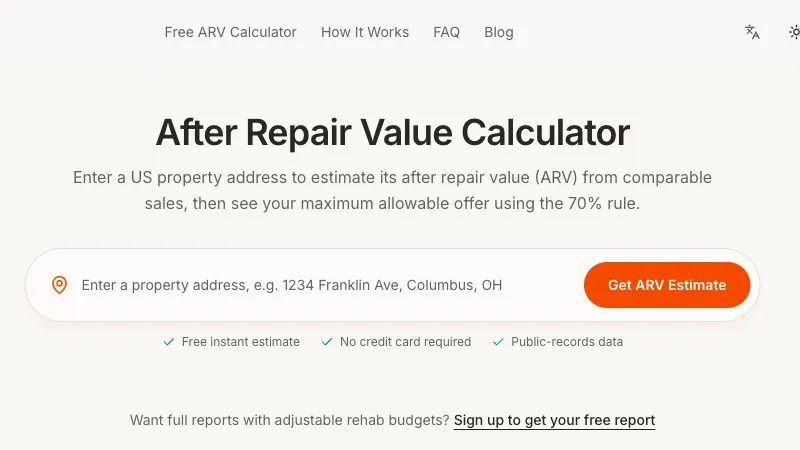
Step 1: Input Subject Property Address
Enter any US residential address into the free ARV calculator to instantly populate verified public property records:
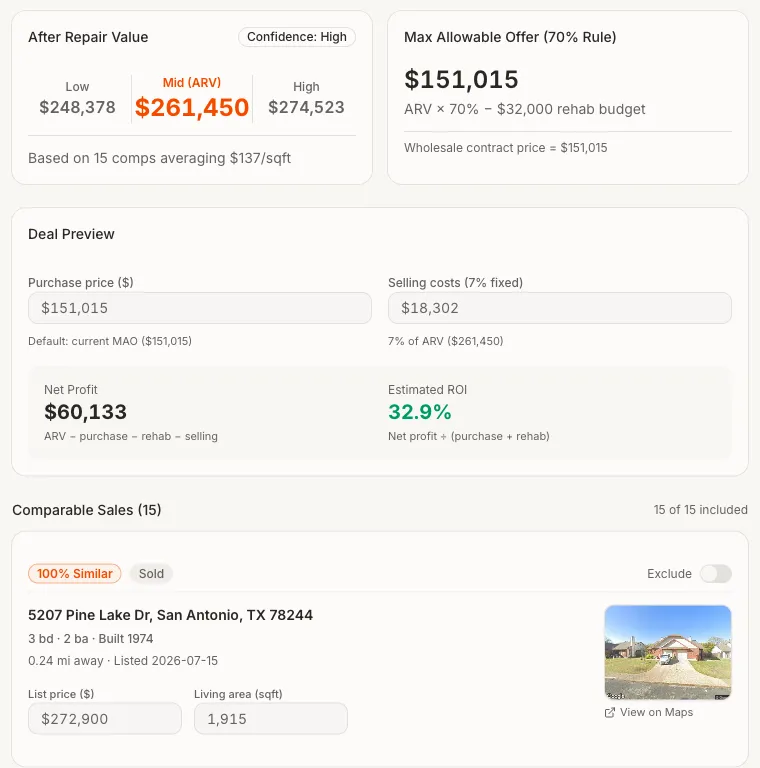
Step 2: Calibrate Recent Sales Comps
Review recent closed transactions pulled directly from public county deeds. Filter by sale date, living square footage, and proximity to establish an unassailable ARV benchmark:

Crucially, professional cash buyers underwrite deals using strict valuation criteria aligned with Fannie Mae Comparable Sales guidelines. ARVHQ applies standard property feature adjustments modeled after standard Fannie Mae feature adjustment guidelines, guaranteeing that your baseline numbers mirror institutional appraisal standards.
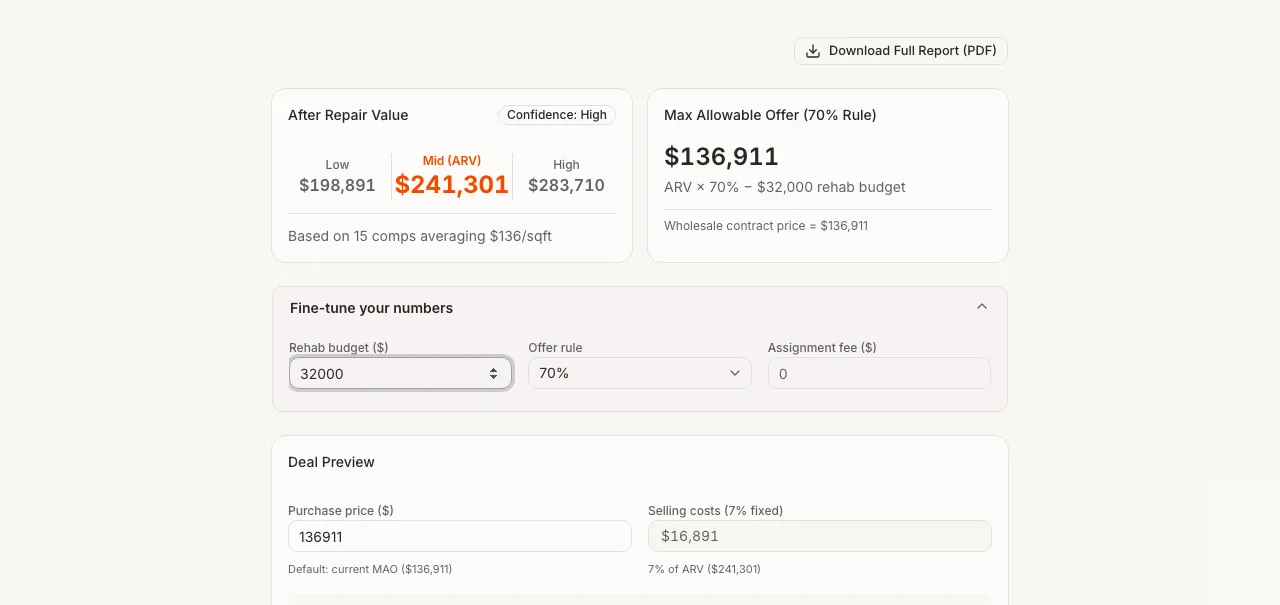
Step 3: Model Repair Budgets and Reverse-Engineer Wholesale Assignment Fees
Input your estimated renovation scope and analyze the automated maximum offer calculations. Toggle between 70%, 75%, and 80% discount scenarios to pinpoint the exact buyer purchase ceiling and deduct your desired assignment spread:
The interactive sliders allow you to test how changes in repair estimates or carrying costs adjust the allowable assignment spread:
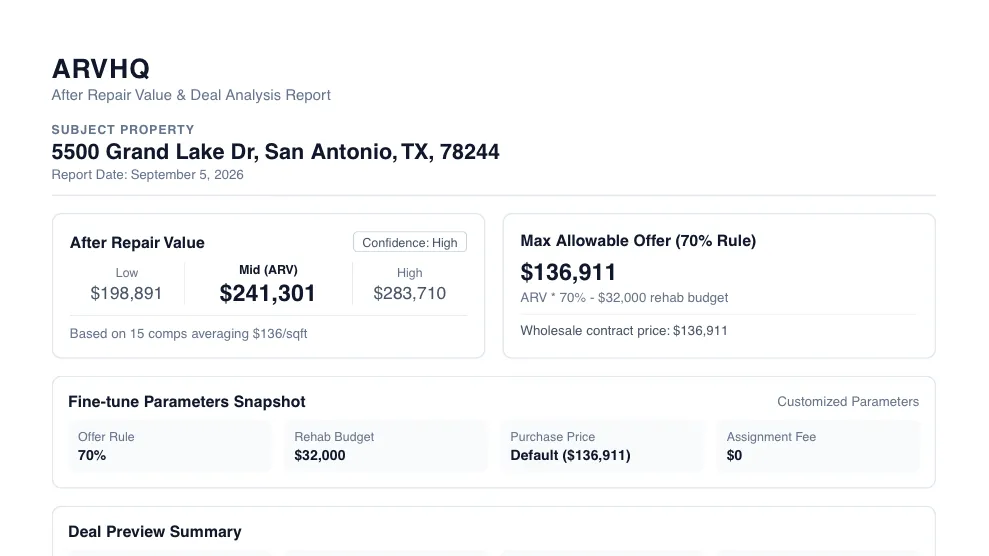
Step 4: Export Comprehensive Property Dossiers for Cash Buyers
When marketing your contract to your buyer list, presenting vague text messages destroys credibility. Export a comprehensive PDF deal dossier with one click to prove your ARV and justify your assignment fee:
A note on transparency: ARVHQ is operated by the team behind this article, and its comps come from RentCast's nationwide database of public county-recorded sales — not real-time MLS feeds. Data sources and AI involvement are described on our AI disclosure page. New accounts get three free reports, and for high-stakes deals we always recommend verifying any automated estimate against your own comp check or a licensed appraisal. Utilizing ARVHQ makes calculating a wholesale assignment fee and validating buyer spreads effortless and precise.
Frequently Asked Questions
Below are concise, direct answers to the most common questions real estate investors and wholesalers ask regarding the wholesale assignment fee:
Who pays the wholesale assignment fee?
In virtually all wholesale transactions, the end cash buyer pays the wholesale assignment fee at the closing table as an itemized line item on the ALTA or HUD-1 settlement statement. The end buyer wires the total funds required for acquisition—which includes the seller's contract price, closing fees, and your assignment fee. The title company or closing attorney disburses the net fee directly to your business account upon final deed recordation.
What is a normal wholesale assignment fee on a flip?
Because private assignment spreads are not tracked in public property recording databases, there is no official statistical average. Instead, professional investors rely on practical rules of thumb modeled across property deal tiers (as outlined in Table 1). For a median single-family flip, practitioners generally target a wholesale assignment fee between $5,000 and $15,000 (roughly 5% to 10% of contract acquisition price). On lower-priced cosmetic properties under $100,000, modeled spreads narrow to $3,000 to $6,000. Conversely, in high-priced metro infill markets or deeply discounted probate deals, experienced wholesalers frequently secure a wholesale assignment fee exceeding $25,000 to $40,000 based on substantial available gross spreads.
Is a wholesale assignment fee legal in real estate?
Yes, collecting a wholesale assignment fee is entirely legal under standard common-law contract doctrine, provided the wholesaler has acquired equitable interest through an enforceable purchase agreement and is transferring contractual rights rather than acting as an unlicensed broker. However, specific jurisdictions—including Illinois and Oklahoma—have enacted statutes restricting unlicensed wholesaling volume or requiring real estate licensing if an individual assigns multiple residential contracts within a 12-month calendar window. Always verify municipal and state assignment statutes before marketing contracts.
Do you need a real estate license to earn a wholesale assignment fee?
No, you generally do not need a real estate license to earn a wholesale assignment fee because you are transacting as a principal party in the contract rather than a licensed agent representing a client. Licensed agents owe fiduciary duties and collect commissions for negotiating property sales between third parties. In contrast, an unlicensed wholesaler is merely liquidating their own personal contractual asset. To remain strictly compliant, wholesalers must market the purchase contract itself, never advertise that they own the physical real property, and disclose their assignment intent in writing.
To reverse-engineer a profitable wholesale assignment fee on your next off-market property and establish an unassailable cash buyer purchase ceiling in seconds, run your address through the free ARV calculator and unlock your first three complimentary valuation reports.