
Max Allowable Offer Real Estate: MAO Formula & Calculator Guide
Master the max allowable offer real estate formula: calculate MAO for flips and wholesale deals, break down every cost line item, and protect profit margins.

In residential property acquisition, the difference between an institutional operator and a struggling amateur comes down to underwriting discipline: you make your money when you buy, not when you sell. To ensure that every acquisition leaves room for carrying debt, unexpected renovation overruns, and target profit, investors calculate the max allowable offer real estate benchmark, universally referred to across the industry as MAO.
Your max allowable offer real estate figure is not an opening bid or a casual negotiation suggestion. It represents your absolute mathematical strike price: the highest dollar amount you can contractually commit to purchase a property while keeping your investment thesis solvent. Whether you are an active house flipper underwriting six-month construction timelines or an off-market wholesaler packaging contracts for cash buyers, knowing how to determine your max allowable offer real estate ceiling is your ultimate defense against capital destruction.
This comprehensive operational guide deconstructs the max allowable offer real estate methodology. We break down the two primary iterations of the mao formula, analyze every variable across the deal ledger, provide two fully reconciled case studies for flippers and wholesalers, and illustrate how automated tools simplify execution. For a deep examination of rule-of-thumb origin, holding percentages, and market deviation thresholds, consult our companion analysis on the 70 percent rule real estate.
TL;DR: Max Allowable Offer Real Estate in 30 Seconds
Short on time? Here is the core operational framework for max allowable offer real estate:
- What Is MAO?: In mao real estate, your Maximum Allowable Offer is the strict ceiling purchase price that accounts for all acquisition expenses, holding costs, construction budgets, disposition fees, and required margins.
- The Wholesaler MAO Formula: Maximum Allowable Offer = (ARV × Rule Percentage) − Estimated Repair Costs − Wholesale Assignment Fee.
- The Flipper Line-Item MAO Formula: Maximum Allowable Offer = ARV − Renovation Budget − Projected Holding Costs − Buying & Selling Transaction Fees − Minimum Target Net Profit.
- The Starting Point: Every valid max allowable offer real estate calculation depends upon an accurate valuation; review our walkthrough on how to calculate ARV before submitting bids.
- Instant Deal Verification: You can calculate and stress-test your numbers immediately using our free ARV calculator.
Comparing the Three MAO Formula Frameworks
Underwriters apply different versions of the mao formula depending on deal velocity and capital commitment. The table below compares the three primary underwriting frameworks used to determine max allowable offer real estate:
| Framework | Core Formula | Best Use Case | Accuracy | Primary Limitation |
|---|---|---|---|---|
| Quick Percentage MAO | (ARV × 70%) − Rehab | Rapid screening of off-market inbound leads | Moderate | Ignores property-specific carrying debt and municipal fee variances |
| Wholesaler Assignment MAO | (ARV × 70%) − Rehab − Wholesale Fee | Contracting properties for assignment to cash buyers | High for wholesale | Relies on end-buyer flipper operating within standard 70% parameters |
| Comprehensive Line-Item MAO | ARV − Rehab − Holding − Closing − Target Profit | High-capital acquisitions, complex rehabs, institutional flips | Highest (Institutional) | Requires itemized contractor bids and detailed loan amortization schedules |
What Is Max Allowable Offer (MAO) in Real Estate?
In off-market acquisitions, max allowable offer real estate underwriting establishes the non-negotiable ceiling for property purchase contracts. When negotiating with distressed sellers, emotional discipline is critical. Sellers frequently present subjective rationales for higher pricing, citing personal memories or aspirational listing portal estimates. Calculating a defensible max allowable offer real estate number equips you with objective data, ensuring you never let competitive tension drive your bid into negative equity territory.
In practical mao real estate operations, the MAO calculation serves three distinct market participants:
- Fix-and-Flip Operators: Flippers use max allowable offer real estate calculations to ensure that after funding four to eight months of hard money debt service, municipal permits, materials, and retail brokerage commissions, they retain an acceptable net profit margin.
- Real Estate Wholesalers: Wholesalers calculate the max allowable offer real estate ceiling to protect both their fee and their assignment liquidity. If a wholesaler contracts a home above the end buyer's MAO, no investor will accept the assignment, and the deal collapses.
- Private and Hard Money Lenders: Asset-based lenders review the sponsor's max allowable offer real estate underwriting to confirm that loan-to-cost (LTC) and loan-to-value (LTV) covenants remain within institutional underwriting guardrails.
As analyzed in institutional underwriting models from Wall Street Prep, establishing your MAO upfront creates an objective financial fence. Crucially, in mao real estate, your MAO is your walk-away number. If a seller rejects an offer equal to your max allowable offer real estate calculation and demands an additional five thousand dollars, you do not simply compromise your numbers; you decline the contract or adjust the scope of work.
The Two Core Formulas: Calculating Max Allowable Offer Real Estate
Practitioners calculate max allowable offer real estate using two distinct mathematical methodologies: the percentage method and the itemized bottom-up method. Knowing which mao formula to apply depends on your acquisition role and deal complexity.
Method 1: The Percentage-Based MAO Formula
The percentage-based mao formula is the industry workhorse for speed. It discounts the after repair value by a set percentage (most commonly 70%, though adjusted to 75% or 80% in competitive regions as documented by The Motley Fool) to automatically bundle holding, closing, and profit margins into a single coefficient:
For Fix-and-Flip Investors: Maximum Allowable Offer = (ARV × Target Rule Percentage) − Estimated Repair Costs
For Real Estate Wholesalers: Maximum Allowable Offer = (ARV × Target Rule Percentage) − Estimated Repair Costs − Wholesale Assignment Fee
In this variation of the max allowable offer real estate equation, the investor applies the target percentage (e.g., 70%), subtracts the contractor's scope of work, and—for wholesalers—deducts the desired assignment fee (typically $5,000 to $20,000). The resulting figure represents the highest purchase price that can be written onto the purchase agreement.
Method 2: The Itemized Bottom-Up MAO Formula
While the percentage method is ideal for triage, institutional redevelopers executing substantial renovations rely on the comprehensive itemized mao formula. Rather than relying on a generalized percentage spread, this max allowable offer real estate formula subtracts every projected expenditure individually:
Maximum Allowable Offer = ARV − Renovation Budget − Projected Holding Costs − Total Acquisition Costs − Total Disposition Costs − Target Net Profit
This zero-guesswork max allowable offer real estate approach eliminates broad assumptions. If a property incurs an unusually high property tax rate, requires private capital at elevated benchmark interest rates, or demands specialized municipal zoning permits, the itemized mao formula captures those expenses directly.
Item-by-Item Breakdown of Every MAO Variable
To execute an unassailable max allowable offer real estate calculation, you must master the mechanics of each underlying variable. Let us examine the six components that dictate your final offer price:
After Repair Value (ARV)
├── Less: Renovation & Construction Budget
├── Less: Acquisition & Financing Costs
├── Less: Monthly Holding & Carrying Costs
├── Less: Disposition & Resale Brokerage Fees
├── Less: Wholesale Assignment Fee (if applicable)
└── Less: Target Net Profit Margin
────────────────────────────────────────────────
= Max Allowable Offer (MAO)
1. After Repair Value (ARV)
The foundation of every max allowable offer real estate calculation is the after repair value. ARV represents the price a property will command on the open market once fully renovated to current neighborhood standards.
You cannot estimate ARV by looking at active listing prices, which represent seller hopes rather than transacted capital. Underwriting requires analyzing recent closed arm's-length transactions. As mandated in the Fannie Mae Comparable Sales guidelines, appraisers and underwriters require at least three closed comparables within close geographic proximity. Feature adjustments must be derived from market evidence, adhering to standards outlined in the Fannie Mae sales adjustment framework. To master this initial stage of your max allowable offer real estate process, review our guide on how to find comps in real estate.
2. Estimated Renovation Costs (Rehab Budget)
The second largest deduction in the max allowable offer real estate equation is the construction budget. A proper renovation estimate must encompass:
- Demolition and debris disposal.
- Structural repairs (foundation leveling, framing, subfloor remediation).
- Major mechanical systems (HVAC, electrical service panels, copper/PEX re-piping, roof replacement).
- Cosmetic finishes (cabinetry, stone counters, tile surrounds, flooring, paint).
- Municipal building permits and inspection fees.
- A mandatory 10% to 15% contingency reserve for concealed defects.
Furthermore, how these expenses are treated on your balance sheet matters. The internal revenue code separates immediately deductible maintenance from capital improvements that must be depreciated or capitalized, as detailed in IRS Publication 527. Mischaracterizing structural expenditures distorts both your cash planning and your max allowable offer real estate underwriting.
3. Acquisition and Financing Costs
Unless you purchase exclusively with unleveraged cash, acquiring distressed assets requires capital with origination fees. Asset-based lenders charge 1.5 to 3 origination points, underwriting fees, and appraisal costs. Furthermore, buyers must pay title examination fees, settlement agent charges, and municipal deed recording taxes. In higher interest rate environments, tracked through the Federal Reserve benchmark rate releases, financing overhead constitutes a meaningful deduction within your max allowable offer real estate calculation.
4. Holding and Carrying Costs
While renovations progress, properties incur uninterrupted monthly carrying overhead:
- Debt service (monthly interest payments on debt capital).
- Real estate ad valorem property taxes.
- Builder's risk and vacant structure hazard insurance.
- Utility services (water, electrical service, gas heating during winter).
- HOA dues, landscaping maintenance, and security monitoring.
On a typical six-month turnaround, holding expenses routinely consume 3% to 5% of ARV. Neglecting holding overhead is the single most common reason beginners miscalculate their max allowable offer real estate target.
5. Disposition and Selling Costs
When your renovated property is sold on the open retail market, gross proceeds are reduced by transactional settlement expenses:
- Brokerage commissions (5% to 6% divided between listing and buyer brokers).
- Seller-paid transfer taxes and state documentary stamps.
- Owner's title insurance policy and escrow closing fees.
- Buyer closing concessions (typically 1% to 2% in normalizing markets).
Combined retail disposition charges generally total 7% to 9% of the final sale price.
6. Target Net Profit or Wholesale Assignment Fee
Finally, the max allowable offer real estate equation must account for your compensation:
- For House Flippers: A minimum dollar profit of $30,000 to $50,000, or a return of 12% to 15% of ARV, is required to justify operational execution and capital exposure.
- For Wholesalers: A wholesale assignment fee (typically $5,000 to $15,000 on median homes, or $20,000+ on higher-value properties) is deducted to establish your contract price.
Worked Case Studies: Calculating MAO Step-by-Step
To see how the max allowable offer real estate math functions across different transaction structures, let us examine two practical case studies for the same residential property.
Scenario Baseline: Single-Family Residence in Columbus, OH
- Property: 1,750 sq ft brick ranch home built in 1978.
- As-Is Condition: Heavily distressed estate sale; requires complete cosmetic overhaul, new roof, and updated HVAC.
- Verified ARV: Comps indicate a fully renovated value of $300,000.
- Contractor Scope of Work: Detailed line-item estimate totals $45,000.
Case Study A: The Wholesaler MAO Calculation
As a real estate wholesaler, you aim to secure the property under contract and assign it to a local cash buyer for a $10,000 assignment fee. Your end buyer requires deals priced under the standard 70% guideline.
Apply the wholesaler mao formula:
Maximum Allowable Offer = (ARV × 70%) − Rehab Budget − Wholesale Fee
- Calculate 70% of the ARV: $300,000 × 0.70 = $210,000
- Deduct the renovation scope: $210,000 − $45,000 = $165,000 (End-buyer flipper MAO)
- Deduct your wholesale assignment fee: $165,000 − $10,000 = $155,000
Your max allowable offer real estate ceiling to the homeowner is $155,000.
- You contract the property with the seller for $155,000.
- You assign the purchase contract to your cash buyer for $165,000.
- At closing, the title company disburses your $10,000 wholesale fee, while the cash buyer acquires the deal at their exact $165,000 MAO ceiling.
Case Study B: The Flipper Itemized MAO Calculation
Now suppose you are the fix-and-flip investor purchasing this property directly. Rather than relying on a generalized 70% assumption, you underwrite the deal using the itemized max allowable offer real estate formula:
- Projected ARV: $300,000
- Renovation Budget: $45,000
- Project Timeline: 5 months (3 months rehab, 2 months listing and escrow)
- Acquisition Financing & Closing: $6,500 (2 points plus title fees on private loan)
- Holding Costs (5 Months): $7,500 ($1,000/mo interest + $300/mo taxes + $200/mo insurance and utilities)
- Disposition Commissions & Closing (7.5%): $22,500
- Required Minimum Net Profit: $48,000 (16.0% of ARV)
Apply the itemized max allowable offer real estate formula:
Maximum Allowable Offer = ARV − Rehab − Financing − Holding − Disposition − Target Profit
- Total deductions: $45,000 rehab + $6,500 financing + $7,500 holding + $22,500 selling + $48,000 profit = $129,500
- Subtract from ARV: $300,000 − $129,500 = $170,500
- Maximum Allowable Offer = $170,500
Using line-item underwriting, your max allowable offer real estate ceiling is $170,500. Because your holding and financing costs were modest, you can bid up to $170,500 and still achieve your full $48,000 net profit target. This demonstrates why itemized mao real estate analysis provides a competitive advantage over rigid percentage heuristics.
Flipper vs. Wholesaler: Why MAO Differs for the Same Property
A frequent source of confusion in off-market deal structuring is why different investors calculate different max allowable offer real estate figures for the exact same physical parcel.
The variance stems from cost of capital, operational capacity, and profit models:
| Investor Type | Primary Capital Cost | Renovation Cost Basis | Minimum Margin Target | Resulting MAO Dynamic |
|---|---|---|---|---|
| Wholesaler | Minimal (Earnest money deposit only) | N/A (Pass-through to buyer) | Fixed fee ($5,000 to $15,000) | Must discount the contract below retail investor MAO to preserve assignment liquidity |
| Novice Retail Flipper | High (Hard money at 12% + 2 points) | Retail contractor pricing ($55k) | 15% to 20% of ARV | Lowest MAO: requires larger safety buffers to survive operational learning curves |
| Experienced Operator | Low (Private equity or bank line at 8%) | In-house crew pricing ($40k) | 12% to 15% of ARV | Highest MAO: operational efficiencies allow higher competitive purchase offers |
Because an established operator with in-house trades and low-cost debt carries lower overhead, their max allowable offer real estate ceiling is naturally higher than that of an inexperienced flipper relying on expensive debt. Understanding your end buyer's cost structure is the secret to successful wholesaling in mao real estate.
Calculating Your Max Allowable Offer Real Estate with ARVHQ
Calculating multiple scenarios by hand across county deed databases and spreadsheets creates bottlenecks in your acquisition pipeline. ARVHQ automates the entire max allowable offer real estate calculation sequence, delivering defensible valuation reports in seconds.
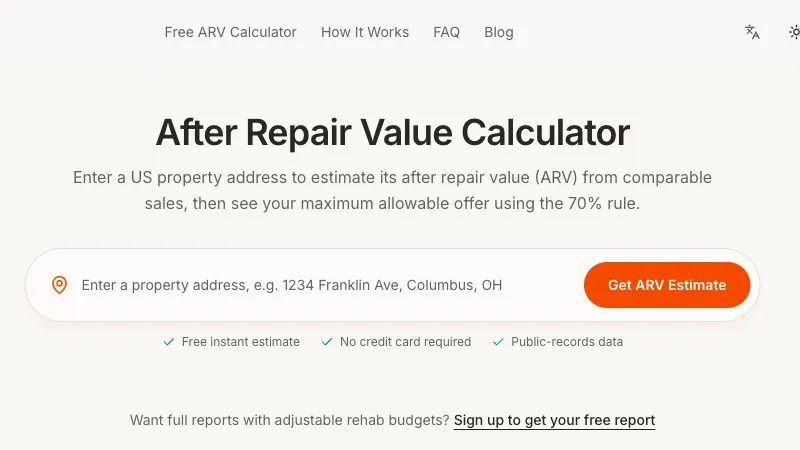
Step 1: Input the Subject Address
Enter any residential address into the free ARV calculator to generate instant valuation parameters:
Step 2: Review and Adjust Verified Comparable Sales
ARVHQ pulls verified closed transactions directly from recorded county sales records, filtering by distance, sale date, and property characteristics:
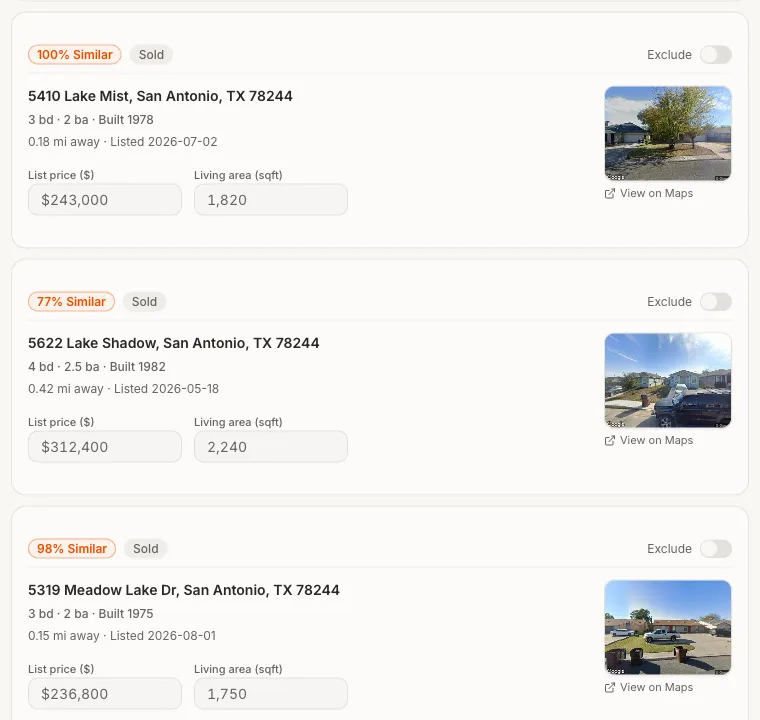
You can inspect individual comp similarity ratings, adjust living areas, or exclude non-renovated sales to ensure your ARV foundation is rock solid.
Step 3: Interactive MAO Fine-Tuning
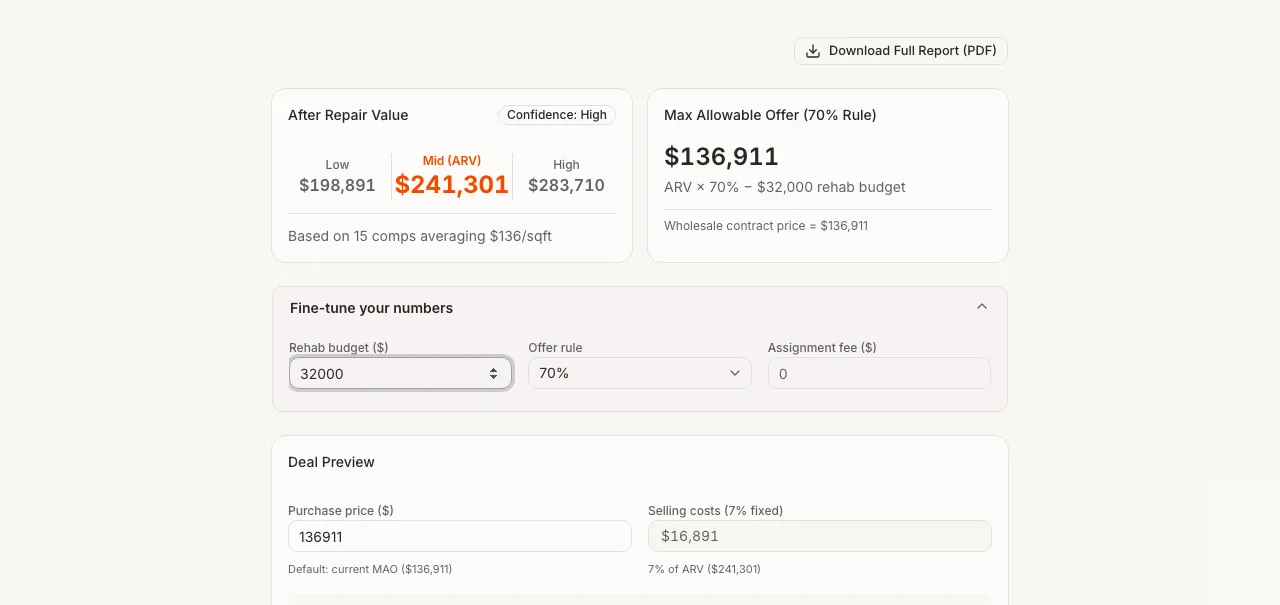
Once comps are aligned, ARVHQ generates your low, mid, and high ARV estimates alongside an automated max allowable offer real estate calculation:
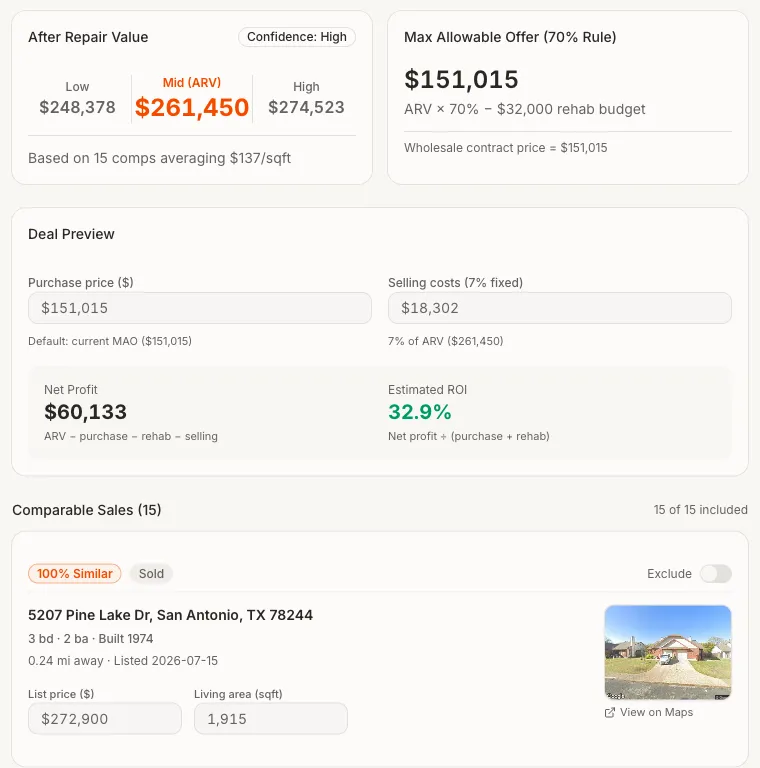
You can slide your rehab budget up or down, toggle between offer rules (70%, 75%, 80%, or custom), and instantly review your projected net profit and cash-on-cash ROI.
Step 4: Export Defensible Deal Reports
When presenting an offer to a seller, private lender, or wholesale buyer, clear presentation builds credibility. ARVHQ exports comprehensive underwriting reports in downloadable PDF format:
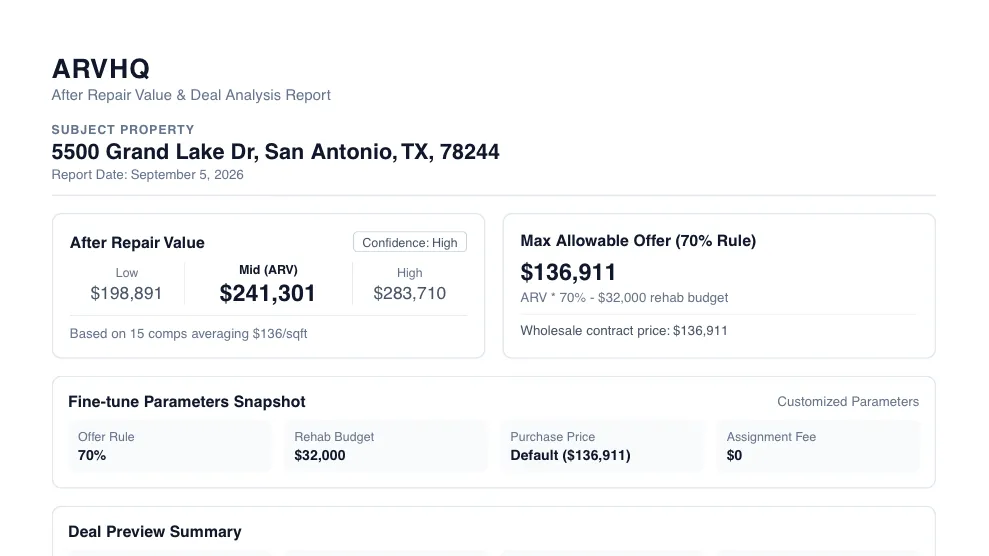
A note on transparency: ARVHQ is operated by the team behind this article, and its comps come from RentCast's nationwide database of public county-recorded sales — not real-time MLS feeds. Data sources and AI involvement are described on our AI disclosure page. New accounts get three free reports, and for high-stakes deals we always recommend verifying any automated estimate against your own comp check or a licensed appraisal. Automating your max allowable offer real estate workflow ensures you make competitive offers quickly without sacrificing underwriting discipline.
Frequently Asked Questions
Below are direct answers to the most common questions surrounding max allowable offer real estate calculations:
What does MAO stand for in real estate?
MAO stands for Maximum Allowable Offer. In residential property investing, it represents the absolute highest price an investor or wholesaler can pay for a property to ensure that all renovation costs, financing expenses, holding overhead, selling fees, and minimum profit margins are fully protected.
What is the standard MAO formula for wholesalers?
The standard wholesale mao formula is: MAO = (ARV × 70%) − Estimated Renovation Costs − Wholesale Assignment Fee. By deducting the assignment fee from the standard 70% formula, the wholesaler ensures the contracted price is low enough to allow a cash buyer to purchase the assignment, renovate the home, and still earn a full profit.
How does MAO differ from ARV?
ARV (After Repair Value) is the projected retail market value of a property after all planned improvements are completed. In contrast, MAO (Maximum Allowable Offer) is the maximum purchase price you can pay for the property today in its as-is condition. ARV represents future gross revenue; MAO represents your current acquisition ceiling.
Should I ever offer above my calculated MAO?
No. Offering above your calculated max allowable offer real estate ceiling actively compromises your profit margin or removes your contingency cushion for unexpected repairs. If a seller demands a price above your MAO, your only prudent options are to negotiate seller-paid closing costs, reduce the scope of renovation, or walk away from the deal entirely.
To screen your next acquisition against institutional underwriting standards, run your address through the free ARV calculator and generate your first three complimentary valuation reports today.