
How to Calculate ARV in Real Estate: Step-by-Step Guide
Learn how to calculate ARV step by step: the after repair value formula, a six-step comps method with a worked example, and the 70% rule for your max offer.

Every profitable deal starts with one number: the after repair value, or ARV — the price a property should sell for once your renovations are finished. Offer too much and the deal eats your profit; offer too little and a competitor takes it. Learning how to calculate ARV from real comparable sales is what turns that guesswork into a defensible number you can underwrite, pitch to lenders, and bid with confidence.
This guide breaks down how to calculate ARV step by step: the formulas behind it, the six-step comps method investors actually use, a fully worked example, and the way ARV feeds your maximum offer through the 70% rule. By the end, how to calculate ARV will feel less like an appraisal mystery and more like arithmetic with judgment on top.
TL;DR: How to Calculate ARV in Six Steps
Short on time? Here is the whole method for how to calculate ARV on a residential property:
- Select three to five valid comps — renovated, recently sold homes that closely match your subject property.
- Convert each comp to price per square foot by dividing its sold price by its living area.
- Adjust each comp up or down in dollars for the features that differ from your subject.
- Average the adjusted price per square foot across your comp set.
- Apply the ARV formula: average price per square foot × your subject's square footage.
- Turn ARV into a maximum offer with the 70% rule: ARV × 70%, minus your repair budget.
Below, every step of how to calculate ARV is walked through with real numbers — or run the whole calculation automatically with the free ARV calculator.
How the Three ARV Methods Compare
Every approach for how to calculate ARV trades speed against precision. Pick the one that matches your housing stock and how much is at stake:
| Method | How it works | Best for | Accuracy | Speed |
|---|---|---|---|---|
| Direct comp average | Average the sold prices of three to six near-identical renovated comps | Tract subdivisions and condo buildings where homes are near-twins | Moderate | Fastest |
| Price per square foot | Multiply the comps' average price per square foot by your subject's square footage | Uniform single-family neighborhoods with minor size differences | High | Fast |
| Line-item adjustment grid | Adjust each comp in dollars for feature differences, then average the adjusted values | Mixed housing stock, older homes, or premium rehabs | Highest (appraisal-style) | Slowest |
Bottom line: for most investors learning how to calculate ARV, the price-per-square-foot method is the baseline; add line-item adjustments whenever your comps differ in bathrooms, garages, or condition — which, in most older neighborhoods, they will.
What Is ARV in Real Estate?
ARV — after repair value — is the estimated market value of a property after all planned repairs and renovations are complete. It is a projection, not a measurement: nobody can promise what a half-renovated house will sell for, so ARV is always an evidence-based estimate of future value.
When investors talk about how to calculate ARV, they are really asking: what will this house, once fixed, be worth to the buyers who will shop for it then? The evidence comes from comparable sales — recently sold homes similar in size, style, age, and, critically, in the renovated condition your subject will be in after your rehab.
Three parties lean on that one number:
- Flippers who know how to calculate ARV use it to set their maximum purchase price before spending a dollar on earnest money.
- Hard money and fix-and-flip lenders underwrite against ARV — the Motley Fool notes these lenders typically cap rehab loans around 65% of ARV.
- Wholesalers use the gap between ARV and their contracted price to price assignments that still leave room for their cash buyers.
That evidence rule is the foundation of how to calculate ARV credibly: closed sales only. An asking price is a seller's opinion; a sold price is money that actually changed hands.
The ARV Formula (After Repair Value Formula)
Practitioners use two versions of the after repair value formula, and knowing how to calculate ARV means knowing when each one applies.
The workhorse — the one this guide teaches — is the comparable sales formula:
ARV = average adjusted comp price per square foot × subject property square footage
It anchors your estimate to what local buyers recently paid for renovated homes and scales it to your subject's size. This is the formula most guides mean when they explain how to calculate ARV, and it is the one appraisal-style valuations are built on.
The conceptual version frames what ARV represents:
ARV = as-is property value + value added by the renovation
Useful for sanity-checking, dangerous as a calculator: one dollar of rehab does not reliably buy one dollar of value. Cosmetic kitchen and bath updates usually return strong premiums, while over-improving a house past the neighborhood's price ceiling rarely does. Wall Street Prep's ARV breakdown reduces the math to purchase price plus renovation cost — but grounding the estimate in comparable sales, rather than in a renovation budget, is what separates a defensible ARV from wishful arithmetic.
How to Determine ARV of a Property: The Six Steps
Here is the full workflow for how to calculate ARV, with one worked example running through it. The numbers are illustrative round figures chosen to show the math — in a real deal, every input comes from your own market.
Step 1: Select Three to Five Valid Comps
Garbage comps in, garbage ARV out — comp selection is where how to calculate ARV is won or lost. Professional appraisers must report a minimum of three closed comparable sales under Fannie Mae's rules, and investors apply the same floor with a tighter filter. For each comp:
- Status: closed sales only — never pending contracts or active listings.
- Recency: sold within the last 90 days, stretching to six months only when inventory is thin (a range the Motley Fool's ARV guide documents as standard investor practice; Fannie Mae directs appraisers to comparable sales closed within the last 12 months — older sales only with explanation).
- Distance: within about a mile of your subject — ideally the same subdivision, on the same side of any highway or school-district line.
- Size: gross living area within roughly 250 square feet of your subject, and the same property style — ranch to ranch, two-story to two-story.
- Condition: the comp must show the finished, updated condition your subject will be in after your rehab. A dated comp values a dated house; it cannot prove your ARV.
Need help building the list itself? Our companion guide on how to find comps in real estate walks the pull step by step using free sources.
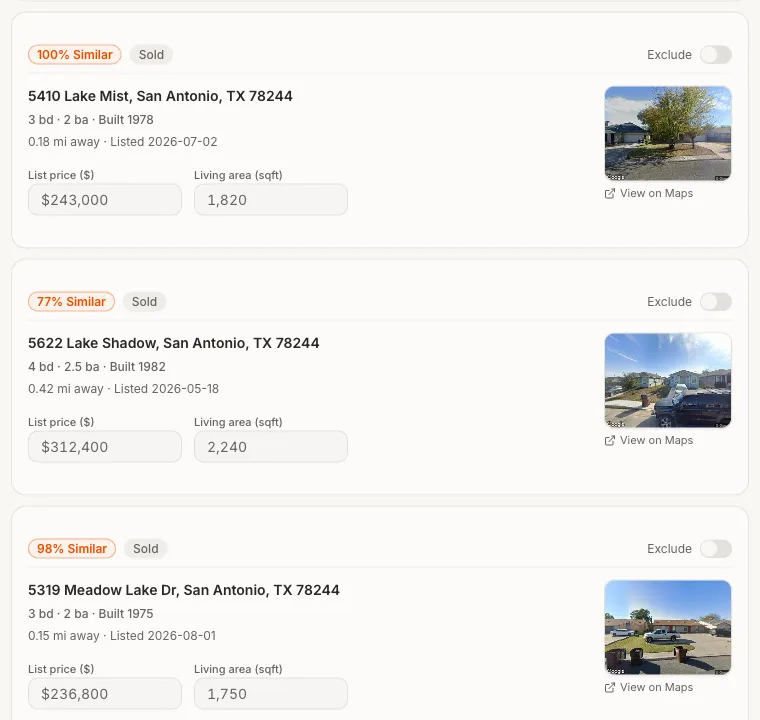
Once pulled, each comp gets reviewed and adjusted — here is what that looks like inside ARVHQ's comp review screen, where every comparable carries a similarity score, a sold badge, and editable price and living-area fields:
Step 2: Convert Every Comp to Price per Square Foot
Divide each comp's sold price by its living area. Normalizing to price per square foot is what lets a 1,450-square-foot comp speak sensibly about a 1,550-square-foot subject — it is the unit of account for how to calculate ARV:
- Comp A: 1,500 sq ft sold for $315,000 → $210.00 per sq ft
- Comp B: 1,600 sq ft sold for $344,000 → $215.00 per sq ft
- Comp C: 1,450 sq ft sold for $297,250 → $205.00 per sq ft
Already the spread is informative — tight comps should cluster within a few dollars per foot of each other. A comp that sits far outside the cluster is telling you something is different about it, and Step 3 is where you find out what.
Step 3: Adjust Each Comp Line by Line
No comp is a perfect twin, so the adjustment pass prices out the differences — in dollars, one feature at a time. This is where how to calculate ARV stops being a formula and becomes local knowledge. If a comp is superior to your subject (an extra bathroom, a two-car garage where your plan has none), adjust the comp down; if the comp is inferior (a dated kitchen where your rehab will install a new one), adjust it up.
Continuing the example — these adjustment amounts are illustrative round numbers; in practice, appraisers derive them from paired sales in your own market:
- Comp B has two full baths where your post-rehab plan has one and a half: adjust down $10,000 → $334,000 ÷ 1,600 sq ft = $208.75 per sq ft
- Comp C sold with a dated kitchen while your renovation includes a new one: adjust up $8,000 → $305,250 ÷ 1,450 sq ft = $210.52 per sq ft
- Comp A needs no adjustment: $210.00 per sq ft
Write down every adjustment and the reason for it. That notes file is what turns your ARV from a hunch into a number you can defend to a lender, a partner, or an appraiser.
Step 4: Average Your Adjusted Price per Square Foot
Average the adjusted figures across the comp set:
($210.00 + $208.75 + $210.52) ÷ 3 = $209.76 per square foot
Averaging is what makes how to calculate ARV robust: no single comp — even your best twin — dictates the number, and one mispriced outlier cannot drag the whole estimate.
Step 5: Apply the ARV Formula to Your Subject Property
Multiply the adjusted average by your subject's above-grade living area. Say your subject measures 1,550 square feet:
$209.76 × 1,550 sq ft = $325,128 — call it an ARV of about $325,000
That one multiplication is the heart of how to calculate ARV — everything before it exists to make it defensible. Round to a number you would actually underwrite, and sanity-check it: an ARV that lands far outside the neighborhood's recent sale range, or far from your unadjusted baseline (here, $210.00 × 1,550 = $325,500), means a comp or an adjustment deserves a second look.
Step 6: Turn ARV into a Maximum Offer with the 70% Rule
An ARV tells you what the house could be worth; it does not tell you what to pay. Converting the two is the last step of how to calculate ARV — the step that pays for all the others. Investors apply the industry-standard 70% rule, as documented in the Motley Fool's ARV formula guide and Freedom Mortgage's investor guide:
Maximum Allowable Offer (MAO) = (ARV × 70%) − estimated repair costs
With our illustrative ARV of $325,000 and a $45,000 rehab budget:
($325,000 × 70%) − $45,000 = $227,500 − $45,000 = $182,500
The 30-point spread is not your profit — it is the buffer that absorbs buying and closing costs, holding costs such as taxes, insurance, and financing, selling commissions, and only then your net margin. In hotter markets, the Motley Fool notes, competitive investors sometimes stretch to 75–80% of ARV, accepting thinner margins to win deals.
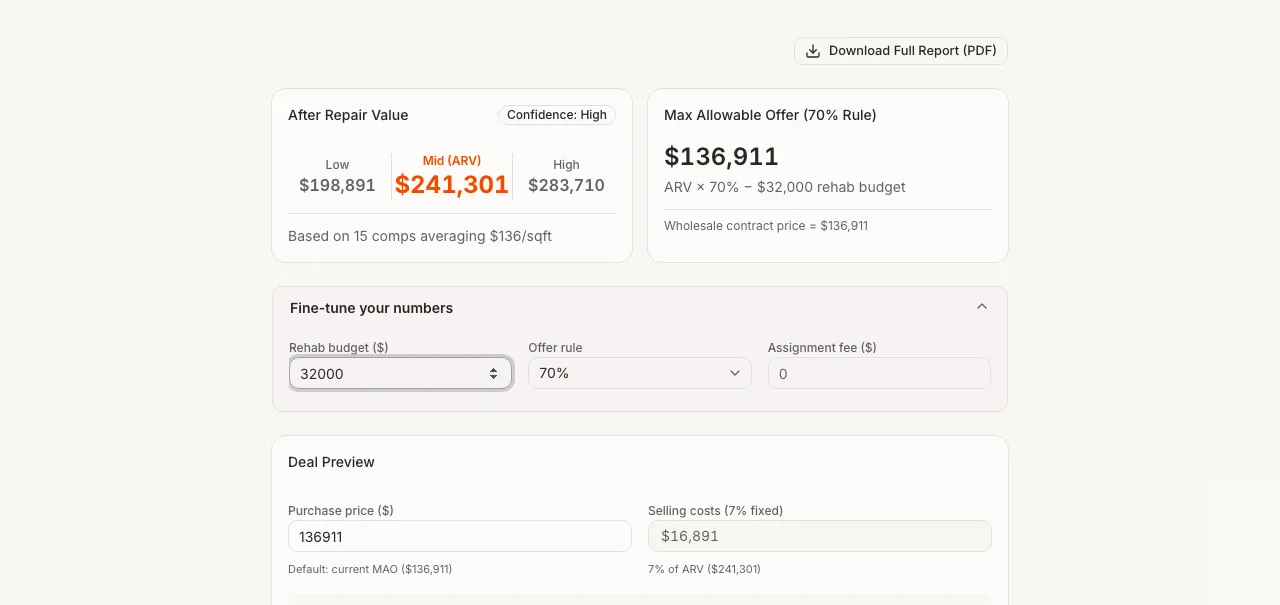
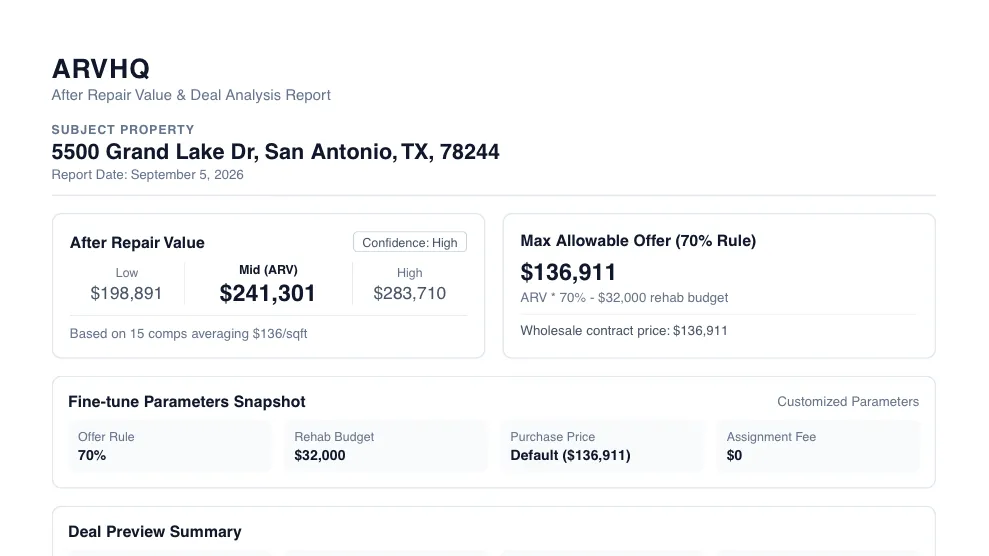
Here is the same arithmetic running live inside ARVHQ — ARV presented as a low/mid/high range with a confidence grade, and the max offer recalculated the moment you change the rehab budget or the offer rule:
ARV vs. Market Value vs. Appraisal
Investors learning how to calculate ARV constantly confuse these three numbers, and mixing them up is expensive. The differences:
| Value type | What it measures | Who relies on it | When it is produced |
|---|---|---|---|
| Market value (as-is) | What the property is worth today, in its current condition | Buyers, sellers, agents pricing a listing | Any time, from current comps |
| ARV | What the property should be worth after a specific renovation plan is completed | Flippers, wholesalers, rehab lenders | Before the rehab, from renovated comps |
| Appraisal | A licensed appraiser's formal opinion of value for a lender | Mortgage lenders and banks | During financing, per strict standards such as Fannie Mae's |
Two consequences follow. First, an ARV is not an appraisal: an appraiser works under lender-mandated rules — closed sales, documented adjustments, defined market areas — and can disagree with an investor's comp set. Second, market value and ARV answer different questions about the same house on the same day; quoting one when a lender or partner expects the other is how deals fall apart at the eleventh hour.
Four Mistakes That Skew Your ARV
Even operators who have already mastered how to calculate ARV make these — and each one quietly corrupts the number everything else builds on:
- Comping from active or pending listings. Asking prices are aspirations. When the market shifts, active listings can sit unsold for weeks while closed sales tell you what buyers actually paid. Only closed sales prove value — it is the first rule of how to calculate ARV.
- Comparing across size brackets. A 1,100 sq ft bungalow and a 2,400 sq ft colonial do not share a price per square foot — smaller homes naturally carry higher per-foot prices, so mixing brackets distorts the average and is a classic trap in how to calculate ARV for older housing stock.
- Over-improving past the neighborhood ceiling. Marble waterfall islands in a working-class subdivision do not raise your ARV; the neighborhood's recent sold prices cap it. Renovate to the top of your comp set, not past it.
- Ignoring soft costs when converting ARV to an offer. Holding costs, lender points, transfer taxes, and resale commissions accumulate for the whole project. The IRS draws the line between deductible repairs and capitalizable improvements in Publication 527 — worth reading before you budget, because misclassifying them skews both your taxes and your deal math.
How to Calculate ARV in Seconds with ARVHQ
Doing the math by hand at least a few times is worth it, because knowing how to calculate ARV manually is what makes you a sharp judge of any automated estimate. But nobody wants to run this six-step sequence across county records at eleven at night, deal after deal.
That is the gap ARVHQ fills. Enter a US property address into the ARV calculator:
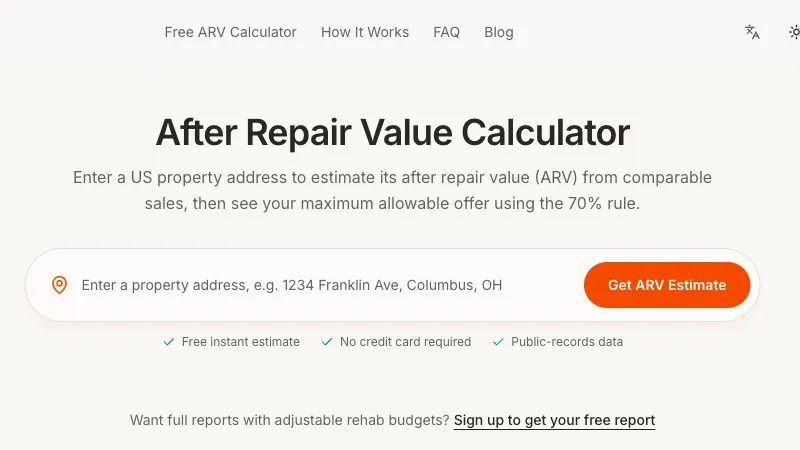
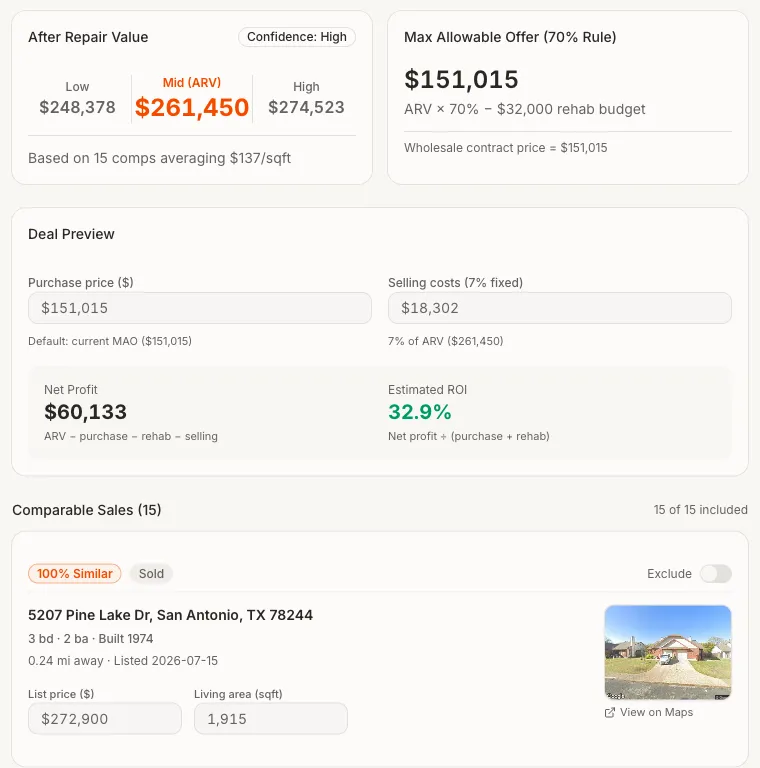
Behind the form, the tool pulls comparable sales, scores each one for similarity, and lets you edit prices and living areas or exclude a comp outright — the adjustment pass from Steps 3 and 4, without the spreadsheet. It then returns the ARV as a low/mid/high range with a confidence grade, a maximum offer based on the 70% rule with an adjustable rehab budget and offer rule, a deal preview of profit and selling costs, and a downloadable PDF report for partners or lenders:
A note on transparency: ARVHQ is operated by the team behind this article, and its comps come from RentCast's nationwide database of public county-recorded sales — not real-time MLS feeds. Data sources and AI involvement are described on our AI disclosure page. New accounts get three free reports, and for high-stakes deals we always recommend verifying any automated estimate against your own comp check or a licensed appraisal. Treat the tool as the fast way to run the numbers — you now know how to calculate ARV by hand whenever you need to check its work.
Frequently Asked Questions
Quick answers to the questions investors ask most about how to calculate ARV:
How many comps do you need to calculate ARV? Three to five tight comps is
the working sweet spot. Fannie Mae requires appraisers to report a minimum of three closed comparable sales, HUD's FHA appraisal standards set the same floor, and three to five is usually enough to average away one mispriced sale — more comps add confidence but also more adjustments to defend.
Can I calculate ARV without MLS access? Yes — how to calculate ARV has never
required an MLS login. Recorded sale prices are public in most counties through assessor and recorder websites, free portals such as Zillow and Redfin map recent closed sales by the "sold" filter, and ARVHQ pulls recorded comps for any US address automatically. ### What is the 70% rule in real estate? It is the investor convention that caps your offer at 70% of ARV minus repair costs: (ARV × 70%) − rehab budget = maximum allowable offer. The 30-point spread reserves room for holding costs, selling costs, and profit; in very competitive markets some investors stretch to 75–80%. The rule is only ever as good as the ARV underneath it — which is exactly why how to calculate ARV comes first. ### Can I use a Zestimate as an ARV comp? No. Automated valuation models like the Zestimate estimate a home's current value from public data — they are not renovation-aware and do not model your finished condition or your specific rehab plan. Zillow itself positions the Zestimate as a starting point, not a substitute for comps or an appraisal. Use it for context, never as one of your three to five comps, and never as a shortcut for how to calculate ARV. ### How accurate is an ARV estimate? Only as accurate as its two inputs: the comps you select and the repair budget you assign. That is why anyone serious about how to calculate ARV thinks in ranges rather than a single point, verifies comps in person, and re-runs the numbers as contractor quotes come in — and why a lender's appraiser may land somewhere different from your figure on the same house. That is how to calculate ARV: select valid sold comps, normalize to price per square foot, adjust honestly, average, apply the formula, and only then convert the number into an offer. When you want the six steps collapsed into seconds, run your address through the free ARV calculator and start with the three free reports.