
Holding Costs in Real Estate: Carrying Cost Formula
Master holding costs in real estate: calculate monthly carrying costs, protect flip profits from construction delays, and reduce loan interest expenses.

In residential redevelopment and property investment, physical renovation expenses represent only half of your operational balance sheet. While novice operators focus obsessively on lumber, tile, and labor quotes, seasoned professionals recognize that time is an expensive financial liability. Every single sunrise a property sits vacant, it steadily consumes capital. Understanding holding costs in real estate is the critical distinction between operators who realize projected cash returns and those who watch their hard-earned equity vanish into monthly debt service and property overhead.
At its foundation, holding costs in real estate—frequently referred to as carrying costs—encompass all recurring operational expenditures required to maintain, finance, insure, and protect a property during acquisition, construction, stabilization, and disposition. Whether you are executing a quick cosmetic flip, managing an extensive structural gut remodel, or stabilizing a long-term rental asset, these ongoing expenses operate continuously on the calendar. Underestimating these ongoing carrying charges is the most pervasive silent killer of project returns in the flipping industry.
This guide provides a comprehensive breakdown of holding costs in real estate. We deconstruct the eight core financial cost drivers, explore the mathematical compounding effect of permit and construction delays, analyze real-world case studies across different timelines, and examine actionable strategies to compress carrying periods. Before committing capital to your next acquisition, underwriting your valuation and timeline using our free ARV calculator guarantees that you establish an adequate financial buffer against unexpected holding delays.
TL;DR: Holding Costs in Real Estate in 30 Seconds
Short on time? Here is what you must know about holding costs in real estate:
- The Core Definition: Holding costs in real estate represent the non-construction overhead accumulated while owning a property: financing interest, origination amortization, property taxes, builder's risk insurance, utilities, maintenance, and HOA dues.
- The Largest Cost Driver: Debt service on short-term hard money or private loans accounts for 60% to 80% of total project carrying overhead, making interest rate benchmarks decisive.
- The Compounding Hazard of Time: A 60-day delay caused by slow municipal permitting or contractor shortages does not add 10% to your costs; it directly subtracts thousands of dollars from your bottom-line net profit.
- Integration with Bidding Formulas: In frameworks like the 70 percent rule in real estate, holding costs represent a primary slice of the 30% spread between purchase price and exit valuation.
- Accurate Pre-Purchase Planning: Controlling your timeline requires establishing an unassailable baseline by learning how to calculate ARV from verified neighborhood comps before acquisition.
Holding Costs Breakdown Across Three Deal Timelines
The impact of holding costs in real estate scales with project duration and capital structure. The table below illustrates how these monthly expenses accumulate across a median $300,000 acquisition financed with typical hard money debt:
| Project Profile | Total Project Duration | Monthly Financing Cost | Monthly Operational Overhead | Total Accumulated Holding Costs | Percentage of Target Net Profit |
|---|---|---|---|---|---|
| 90-Day Fast Cosmetic Turn | 3 Months (45-day rehab, 45-day contract & close) | $2,500 ($300k debt @ 10%) | $750 (Taxes, insurance, power, water) | $9,750 | 18% to 22% of profit |
| 180-Day Standard Renovation | 6 Months (90-day rehab, 45-day list, 45-day close) | $2,500 ($300k debt @ 10%) | $750 (Taxes, insurance, power, water) | $19,500 | 38% to 45% of profit |
| 270-Day Heavy Structural Flip | 9 Months (Permitting delays, heavy framing & MEP) | $2,500 ($300k debt @ 10%) | $850 (Extended utility heating, seasonal lawn) | $30,150 | 65% to 80%+ of profit |
What Are Holding Costs in Real Estate?
Holding costs in real estate represent the continuous expenses incurred while holding title to an asset prior to completing a sale or securing long-term tenant occupancy. Unlike materials or subcontractor payments that produce tangible equity improvements, carrying costs are pure operational friction: dollars spent simply to keep the project solvent and legally compliant during the renovation lifecycle.
To grasp this danger in dollar terms, consider the capital structure of a typical investment. Distressed property renovations are rarely funded with long-term 30-year conventional debt. Instead, flippers and BRRRR investors rely on short-term bridge financing, hard money lenders, or private investor capital carrying interest rates between 9% and 13%. When an asset sits idle for an extra two months waiting on a municipal building inspection, the investor continues paying high-rate interest every single day. If you fail to account for these cumulative carrying costs accurately during initial underwriting, a project that appears profitable on paper can easily result in a net financial loss.
The Eight Primary Drivers of Holding Costs in Real Estate
When analyzing a prospective deal, underwriters must account for eight distinct expense buckets that comprise total holding costs in real estate:
1. Loan Interest and Debt Service
Debt service represents the overwhelming majority of holding costs in real estate. On a $250,000 hard money loan at an 11% interest-only coupon, monthly interest payments total $2,291.67 ($76.39 per day). Macroeconomic shifts established by the Federal Reserve Selected Interest Rates table directly determine the benchmark costs of commercial credit, illustrating why high-rate environments magnify carrying burdens substantially.
2. Property Taxes
County and municipal property taxes accrue every day you hold legal title. While property taxes vary by jurisdiction, an annual tax assessment of $4,800 adds $400 per month ($13.33 per day) to your carrying costs. Investors must verify whether local taxing authorities reassess property values mid-project upon pulling building permits.
3. Vacancy and Builder's Risk Insurance
Standard homeowner insurance policies do not cover vacant residential properties undergoing major construction. Lenders mandate specialized vacant dwelling or builder's risk insurance policies. These policies protect against fire, windstorm, vandalism, and theft of building materials on site, adding $150 to $350 per month to monthly carrying costs.
4. Utilities (Electricity, Gas, Water, Trash)
Renovation crews require active electricity for power tools and lighting, heating or air conditioning to allow drywall mud and paint to cure properly, and water for pressure washing, tile cutting, and mortar mixing. During winter months, heating expenses escalate dramatically to prevent pipe freezes, adding $200 to $500 monthly to holding costs in real estate.
5. HOA and Condominium Fees
Properties situated in planned developments or condominium complexes incur mandatory monthly Homeowners Association (HOA) dues. These charges continue uninterrupted during construction, often adding $100 to $400 per month to holding costs in real estate. Furthermore, some associations assess special transfer fees or require deposits for construction parking.
6. Lawn Maintenance, Snow Removal, and Security
Distressed properties that exhibit overgrown lawns or uncleared sidewalks attract municipal code violations and signal vacancy to vandals. Budgeting regular lawn care ($50 to $100 per bi-weekly cut) and remote wireless job-site camera systems ($50 to $100 monthly) is an essential component of holding costs in real estate.
7. Opportunity Cost of Capital
If an investor deploys $75,000 of their own cash for down payments and construction reserves, that capital is unavailable for other investment opportunities. Factoring in a minimum hurdle rate of return ensures your project balance sheet reflects true economic performance.
8. Tax Deductibility and Accounting Treatment
The tax treatment of holding costs in real estate depends heavily on the investor's business model. For active flippers, carrying costs are generally capitalized into the property's tax basis or deducted as active business expenses under IRS Publication 334 (Tax Guide for Small Business). Conversely, buy-and-hold investors holding properties for long-term rental income must navigate capitalization rules detailed in IRS Publication 527.
Carrying Costs vs. Holding Costs: Industry Terminology and Nuance
In real estate discussions, practitioners frequently use the terms carrying costs and holding costs interchangeably. Both phrases refer to the exact same economic reality: ongoing asset ownership overhead.
As outlined in institutional financial modeling guides like Wall Street Prep's After-Repair Value (ARV) analysis, carrying and holding expenses represent the total capital cost of holding property over time. In commercial development, investors typically refer to carrying costs, whereas residential house flippers more commonly speak of holding costs. Regardless of terminology, the mathematical risk remains identical: whenever the construction or marketing timeline expands, total carrying overhead surges, directly eroding profit margins.
Holding Costs in House Flipping: How Construction Delays Compound Losses
The most dangerous aspect of holding costs for house flippers is that time delays compound non-linearly. To understand why holding costs in real estate represent such an acute hazard, consider the relationship between construction timelines, listing windows, and buyer loan underwriting.
A house flip timeline consists of three distinct phases:
- Renovation Phase: Demolition, rough mechanicals, inspections, and finish installations (typically 60 to 90 days).
- Marketing and Listing Phase: Staging, photography, open houses, and contract negotiation (typically 15 to 45 days).
- Buyer Escrow and Closing Phase: Buyer mortgage underwriting, appraisal, title search, and closing (typically 30 to 45 days).
Notice that even on a project where contractors finish construction on schedule in 60 days, total holding costs in real estate continue accumulating for another 60 to 90 days while the property is marketed and the retail buyer's lender processes the transaction. If municipal permit approvals add 45 days upfront and an appraisal dispute delays buyer financing by 30 days on the backend, total project duration doubles from four months to seven months.
On a typical flip with $3,200 in monthly carrying overhead, that 90-day delay adds $9,600 in unforeseen holding costs in real estate, instantly cutting an expected $35,000 net profit margin by more than 27%.
How to Calculate Holding Costs in Real Estate: Step-by-Step Case Study
To see how to calculate holding costs in real estate accurately during pre-acquisition underwriting, let us examine an itemized scenario for a single-family home flip:
Project Parameters
- Purchase Price: $220,000
- Short-Term Loan Amount (85% LTC): $187,000
- Interest Rate: 10.5% (Interest-only hard money)
- Projected Timeline: 6 Months (180 days)
Monthly Carrying Cost Calculation
- Monthly Debt Service ($187,000 × 10.5% ÷ 12): $1,636.25
- Monthly Property Taxes ($3,600 annual ÷ 12): $300.00
- Monthly Builder's Risk Insurance ($2,100 annual ÷ 12): $175.00
- Monthly Utilities (Power, water, gas, internet camera): $275.00
- Monthly Grounds Maintenance & HOA Dues: $150.00
- Total Monthly Holding Cost: $2,536.25
Total Accumulated Holding Costs
- Baseline 6-Month Holding Cost ($2,536.25 × 6): $15,217.50
- Buffer for 30-Day Contingency Delay (1 Month): $2,536.25
- Total Underwritten Holding Costs in Real Estate: $17,753.75
By explicitly modeling $17,754 in carrying expenses into the acquisition model, the investor ensures that debt service and carrying expenses do not erode their expected net profit.
How to Reduce Holding Costs During a Rehab
Professional investors actively manage their schedules to compress holding costs in real estate. Implementing the following four operational strategies will significantly reduce your carrying expenses:
1. Pre-Order Long-Lead Materials Before Closing
Never wait until closing day to select cabinets, windows, or exterior doors. Pre-ordering materials with 4-to-6-week lead times ensures that supplies arrive on site the day demolition concludes, eliminating costly downtime that inflates project carrying costs.
2. Submit Permit Applications with Expedited Runners
Navigating municipal building departments is a frequent bottleneck. Hiring experienced local permit expediters or utilizing digital pre-submittal reviews cuts weeks off approval timelines, saving thousands in carrying charges.
3. Tie Contractor Draw Schedules to Milestone Deadlines
Structure contractor contracts with performance milestones and completion deadlines. Providing financial bonuses for finishing ahead of schedule aligns contractor incentives with your goal of compressing the construction timeline.
4. Stage and Market Early
Begin professional staging and pre-marketing preparations during final paint touch-ups. Ordering high-resolution photography and launching marketing campaigns the moment the final cleaning finishes ensures you enter contract rapidly, capping carrying expenses before listing fatigue sets in.
Connecting Holding Costs to Downstream Offer Formulas
Properly calculating holding costs in real estate is vital because carrying numbers feed directly into maximum bidding equations:
Connection to the 70% Rule
Under the traditional house flipping guideline, investors calculate offer thresholds using the formula:
Maximum Purchase Price = (ARV × 70%) − Estimated Repairs
As detailed in our analysis of the 70 percent rule in real estate, the 30% spread is not pure profit. It specifically allocates 3% to 5% of ARV to absorb holding costs in real estate. If your carrying timeline stretches past six months, total carrying overhead will exceed this 5% allocation, necessitating a lower offer ceiling to stay protected.
Connection to Maximum Allowable Offer (MAO)
In institutional underwriting, operators avoid percentage rules and model carrying costs explicitly:
MAO = ARV − Renovation − Holding Costs − Transaction Costs − Target Net Profit
Accounting for every dollar of holding and carrying costs ensures your purchase offer preserves your required profit margin. To explore granular line-item bidding models, review our guide on max allowable offer real estate.
Crucially, every holding cost projection relies on an accurate post-repair valuation. Overestimating sales price creates unrealistic profit assumptions that hide holding liabilities. Appraisers calibrate values using closed sales that satisfy Fannie Mae Comparable Sales guidelines, requiring data-driven condition adjustments under the Fannie Mae adjustments framework. To master comp screening, read our walkthrough on how to find comps in real estate.
Underwriting Holding Costs in Real Estate with ARVHQ
Calculating holding costs in real estate manually across multiple scenarios is slow and prone to errors. ARVHQ integrates neighborhood comps with automated offer calculators, enabling investors to underwrite timeline carrying expenses and purchase ceilings effortlessly.
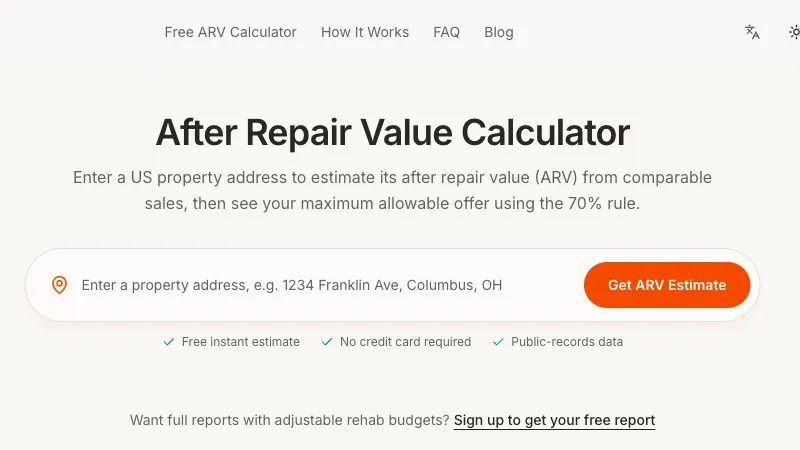
Step 1: Input Subject Property Address
Enter any US residential address into the free ARV calculator to retrieve verified county records:
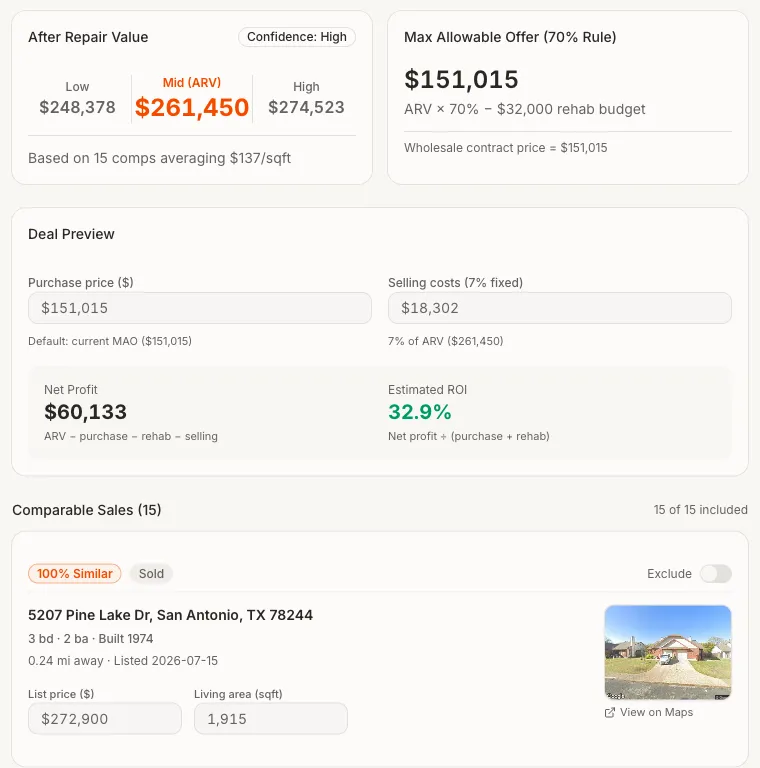
Step 2: Calibrate Recent Sales Comps
Review verified closed transactions pulled from public records. Examine sold dates, living areas, and distance metrics to establish a reliable ARV benchmark:

Step 3: Model Repair Budgets, Holding Costs, and Maximum Offers
Input your estimated renovation budget and examine the real-time maximum allowable offer calculations. Toggle between conservative and aggressive scenarios to observe how timeline delays and holding costs impact net profit:
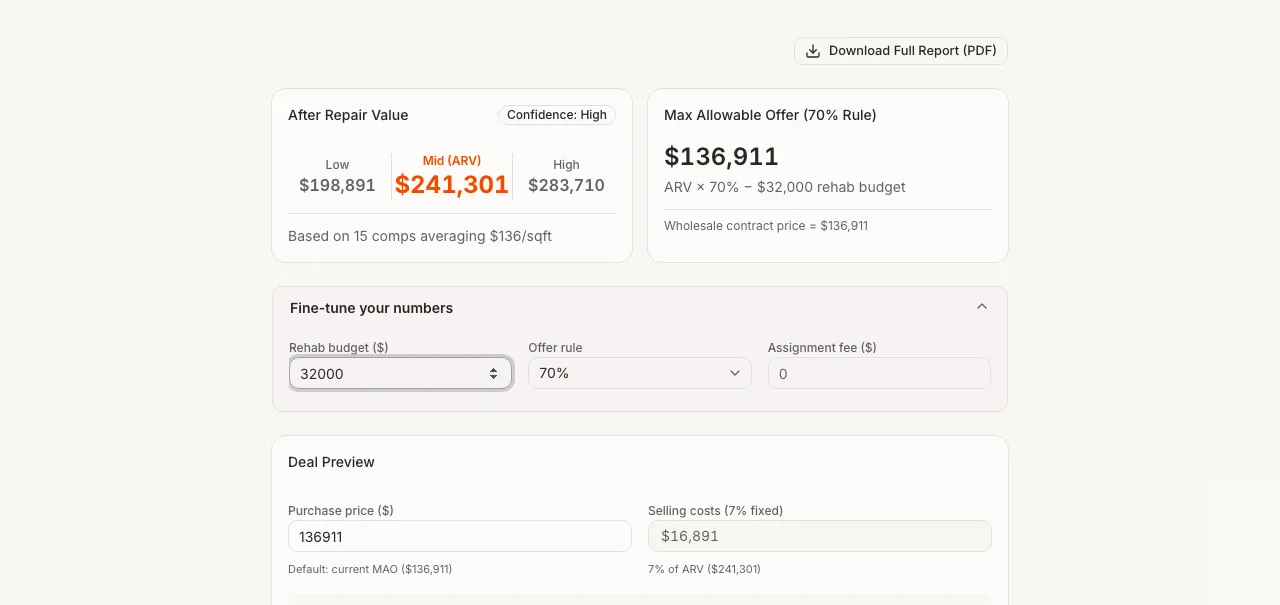
The interactive sliders let you adjust your required return, ensuring that unforeseen timeline delays do not jeopardize your deal returns:
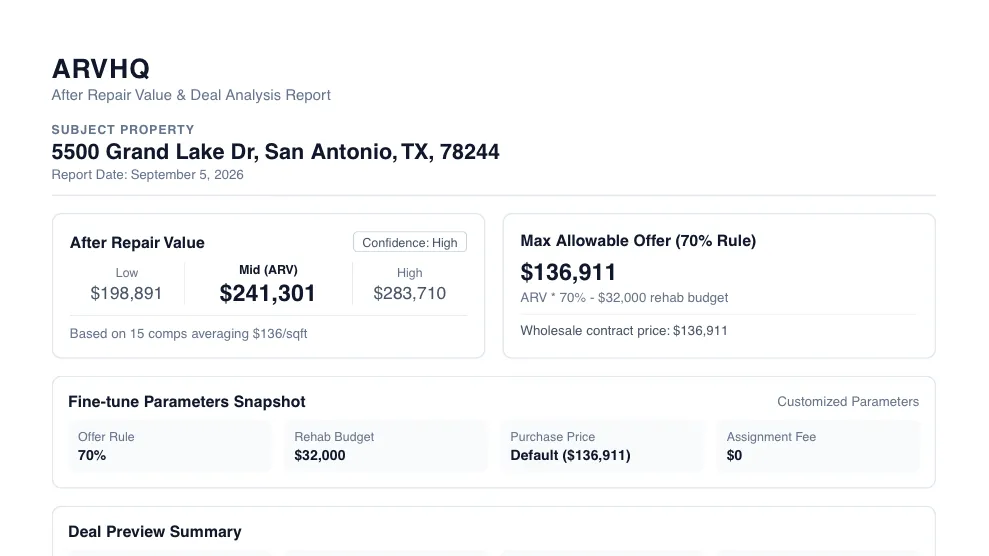
Step 4: Export Comprehensive Underwriting Reports
Presenting itemized deal underwriting to private money partners, hard money lenders, or investment partners builds immediate credibility. Export a professional PDF property dossier with a single click:
A note on transparency: ARVHQ is operated by the team behind this article, and its comps come from RentCast's nationwide database of public county-recorded sales — not real-time MLS feeds. Data sources and AI involvement are described on our AI disclosure page. New accounts get three free reports, and for high-stakes deals we always recommend verifying any automated estimate against your own comp check or a licensed appraisal. Utilizing ARVHQ makes factoring holding costs into every property acquisition reliable and straightforward.
Frequently Asked Questions
What are typical holding costs on a house flip?
Typical holding costs on a house flip range from 1% to 2% of the total acquisition price per month, typically totaling 5% to 9% of the property's After Repair Value over a standard 6-month lifecycle. On a median $300,000 acquisition financed with short-term hard money debt, monthly holding costs in real estate average $2,500 to $3,200. This monthly burn rate encompasses loan interest, property taxes, builder's risk insurance, utilities, and basic grounds maintenance.
Are carrying costs and holding costs the same thing in real estate?
Yes, carrying costs and holding costs represent the exact same economic concept in property investment. Both terms refer to the ongoing, non-renovation overhead expenses incurred while holding title to an asset prior to disposition or stabilization. While commercial developers frequently use the term carrying costs and residential flippers prefer holding costs, both reflect the real cost of time and capital.
How do interest rate hikes affect holding costs?
Interest rate hikes affect holding costs in real estate by increasing the borrowing cost of short-term debt, which comprises the largest component of carrying expenses. Because most hard money and private loans carry floating rates or reflect prevailing central bank benchmark rates, a 2% increase in debt rates adds hundreds of dollars in monthly interest service, expanding total carrying liabilities and compressing project margins.
Can you deduct holding costs on your taxes during a renovation?
Yes, but the specific tax treatment of holding costs in real estate depends on whether you are classified as an active dealer or a passive buy-and-hold investor. Active flippers generally capitalize holding costs into the property's cost basis, deducting them upon sale under the small-business tax rules outlined in IRS Publication 334, while rental investors must follow specific uniform capitalization rules detailed in IRS Publication 527.