
70 Percent Rule Real Estate: Formula, 30% Spread, and When to Break It
Master the 70 percent rule real estate formula: break down the 30% spread, calculate maximum purchase prices, and know when to adjust your offer percentage.

In residential redevelopment, every profitable project begins before closing day: you make your money when you buy, not when you sell. To avoid overpaying for distressed properties, professional flippers and wholesalers rely on the 70 percent rule real estate benchmark. It is the most recognized sanity check in the flipping industry, serving as a rapid filter to separate viable acquisition candidates from deals that will consume your capital.
At its foundation, the 70 percent rule real estate formula calculates a maximum purchase price by discounting the projected after repair value (ARV) by thirty percent and subtracting the estimated cost of renovations. But while the arithmetic is simple, applying the 70 percent rule real estate investors depend upon requires understanding the cost realities buried inside that thirty-point spread. Truncating your underwriting to a mechanical rule without understanding its moving parts is how capital gets trapped in stagnant inventory. Knowing how this pricing guideline functions across different asset types is essential for preserving equity.
This comprehensive guide breaks down the 70 percent rule real estate formula step by step. We examine where the thirty percent spread actually goes, walk through an end-to-end financial case study, examine five real-world scenarios where you must intentionally deviate from seventy percent, and explore how automated valuation tools accelerate deal evaluation. For flippers navigating volatile inventory, this methodology creates a reliable margin of safety. If you need a granular line-item breakdown of buyer and wholesaler margins, be sure to read our companion guide on max allowable offer real estate.
TL;DR: The 70 Percent Rule Real Estate in 30 Seconds
Short on time? Here is how the 70 percent rule real estate formula functions in practice:
- The Core Equation: Maximum Purchase Price = (ARV × 70%) − Estimated Repair Costs.
- The 30% Spread Is Not Pure Profit: That thirty percent cushion must absorb acquisition financing, loan origination points, holding costs, property taxes, insurance, contractor overages, and selling commissions before you collect a dollar of net return.
- Prerequisite Accuracy: The formula is only as dependable as the valuation underneath it; you must first master how to calculate ARV using rigorous, closed comparable sales.
- When to Deviate: In high-priced coastal markets or quick cosmetic turnarounds, practitioners frequently flex up to 75% or 80%. In low-value rural markets or complex gut rehabs, you must drop your ceiling to 60% or 65% to stay protected.
- Automated Verification: You can verify your purchase ceiling instantly using our free ARV calculator.
How the 70 Percent Rule Real Estate Performs Across Five Deal Profiles
Every deal features a different risk profile. The table below illustrates how the baseline 70 percent rule real estate formula holds up across varying price tiers and renovation complexities:
| Deal Profile | Typical ARV & Rehab | Standard 70% Rule Behavior | Adjusted Target Percentage | Why the Standard Rule Fails |
|---|---|---|---|---|
| Median Suburban Flip | $320,000 ARV / $45,000 Rehab | Effective baseline: leaves balanced dollar buffer for debt, closing, and profit | 70% (Standard) | Aligns perfectly with historical average single-family holding timelines and closing fees |
| High-Priced Metro Property | $850,000 ARV / $75,000 Rehab | Excessively conservative: 30% spread ($255,000) generates uncompetitive offers | 75% to 80% | High absolute dollar spreads cover fixed carrying costs easily, permitting narrower percentage margins |
| Entry-Level / Low-Value Home | $80,000 ARV / $25,000 Rehab | Dangerously aggressive: 30% spread ($24,000) is quickly eliminated by fixed fees | 60% to 65% | Fixed costs (escrow fees, utility connections, minimum transfer taxes) consume too large a share of total ARV |
| Heavy Structural Gut Rehab | $280,000 ARV / $100,000 Rehab | Underestimates carrying risk: lengthy permit delays inflate financing expenses | 60% to 65% | Variance on six-month-plus timelines creates substantial holding cost compounding |
| BRRRR Rental Buy-and-Hold | $240,000 ARV / $30,000 Rehab | Disconnect from takeout: long-term lenders refinance up to 75% or 80% LTV | 75% to 78% | The investor intends to refinance rather than pay 6% to 8% retail disposition agent commissions |
What Is the 70 Percent Rule Real Estate?
The 70 percent rule real estate guideline is designed to identify the absolute maximum price an investor can pay for a distressed residential property while retaining an adequate safety margin. By capping your acquisition cost at seventy percent of the projected post-renovation value minus repairs, the 70 percent rule real estate framework protects your venture against market declines, construction delays, and unexpected structural defects.
To see why the 70 percent rule real estate convention has endured for decades, consider the investor balance sheet. House flipping carries asymmetrical risk: materials inflate, municipal permitting departments face backlogs, and mortgage interest rates shift. If an operator purchases a property with only a ten percent buffer, a single foundation repair or two-month sales delay converts an anticipated profit into an outright capital loss. The 70 percent rule real estate framework enforces an institutional discipline, ensuring that bidding emotion never overrides financial reality. Adhering to strict bidding protocols guarantees that you never overbid on off-market inventory.
However, the 70 percent rule real estate equation never operates in a vacuum. It requires two primary inputs:
- After Repair Value (ARV): What the property will honestly sell for on the open market once brought up to modern neighborhood standards.
- Estimated Repair Costs: A comprehensive scope of work encompassing labor, materials, municipal permits, and a contingency reserve.
Before entering an acquisition negotiation, you must establish an unassailable ARV. You cannot guess this number from asking prices or portal estimates. Professional valuation requires selecting recent, closed arm's-length transactions. As outlined in the Fannie Mae Comparable Sales guidelines, valuation requires a minimum of three closed comparables that closed within recent months. Furthermore, adjustments across property features must reflect market-supported data as detailed in the Fannie Mae adjustments framework. To master comp identification, review our walkthrough on how to find comps in real estate.
Deconstructing the 30% Spread: Where Does the Money Actually Go?
The most dangerous misconception held by novices is that the thirty percent spread in the 70 percent rule real estate formula represents pure profit. It does not. If you buy at seventy percent of ARV minus rehab and sell at one hundred percent, you will never pocket a thirty percent return. The formula reserves that thirty percent spread specifically to absorb non-renovation overhead.
Instead, that thirty percent margin must fund four substantial cost buckets before the operator realizes any net income:
- Acquisition & Financing Costs (3% to 5% of ARV)
- Holding Costs (3% to 5% of ARV)
- Selling & Closing Costs (6% to 8% of ARV)
- Target Net Profit Margin (12% to 15% of ARV)
Let us examine each component of this spread in detail:
1. Acquisition and Financing Costs (3% to 5% of ARV)
Distressed acquisitions evaluated under the 70 percent rule real estate method rarely close with conventional conforming mortgages. Investors utilize hard money loans, private capital, or revolving lines of credit. Hard money lenders typically charge 1.5 to 3 origination points upfront, along with document preparation fees, legal underwriting expenses, and appraisal fees. In addition, local governments assess title insurance, recording fees, and municipal transfer taxes. When debt benchmark rates elevate, as tracked on the Federal Reserve Selected Interest Rates table, carrying debt expenses compounds rapidly, demonstrating why this financial buffer is essential.
2. Holding and Carrying Costs (3% to 5% of ARV)
While contractors renovate the structure, capital remains encumbered. The property accumulates recurring monthly overhead that your spread must absorb:
- Debt Service: Monthly interest-only payments to your private or asset-based lender.
- Real Estate Taxes: Property taxes accrue daily regardless of whether a home is inhabited.
- Hazard & Builder's Risk Insurance: Specialized vacant property coverage carries higher premiums than standard homeowner policies.
- Utilities: Water, electricity, gas, and winterization services required during ongoing construction.
- HOA Dues & Maintenance: Lawn care and association assessments necessary to prevent municipal code liens.
On a four-to-six-month project timeline, carrying overhead frequently consumes 3% to 5% of your final resale value, confirming why this allowance cannot be treated as discretionary profit.
3. Selling and Disposition Costs (6% to 8% of ARV)
When the renovation finishes and the home enters the retail market, disposition expenses immediately diminish your gross proceeds. Settlement charges consistently reduce net distributions:
- Real estate brokerage commissions (typically 5% to 6% divided between listing and buyer brokers).
- Seller-paid transfer taxes and deed documentary stamps.
- Owner's title policy fees and settlement escrow charges.
- Seller concessions (frequently 1% to 2% requested by retail buyers for mortgage rate buydowns or inspection remedies).
Without this margin, disposition expenses would directly consume investor capital.
4. Renovation Contingency & Tax Treatment
Construction projects routinely encounter concealed conditions, such as obsolete wiring, galvanized plumbing, or hidden termite damage. Furthermore, the internal revenue code treats residential investment expenses with strict categorization. The distinction between immediately deductible repairs versus capital improvements that must be added to your cost basis is delineated in IRS Publication 527. Failing to account for capital expenditure treatment can distort both your cash reserves and end-of-year tax liability, making an adequate safety cushion indispensable.
5. Target Net Profit Margin (12% to 15% of ARV)
Only after financing, carrying costs, and disposition expenses are paid does the remaining slice of the spread reach your bank account. For an active house flipper taking on operational liability, personal loan guarantees, and project execution risk, a 12% to 15% net return on ARV is the industry minimum required to justify the endeavor.
A Step-by-Step Worked Example of the 70 Percent Rule Real Estate
To understand the mathematical mechanics of the 70 percent rule real estate formula, let us walk through a concrete underwriting scenario with clean numbers.
Step 1: Establish the Subject Property Baseline
Suppose you evaluate an off-market three-bedroom, two-bathroom ranch style home in an established suburban neighborhood:
- Subject Property: 1,600 square foot single-family residence.
- Current Condition: Dated 1980s interiors, worn roof, non-functioning HVAC, original kitchen cabinetry.
- Comparable Sales Analysis: Three recent renovated sales within a half-mile radius establish a rock-solid ARV of $320,000 ($200 per square foot).
Step 2: Formulate the Scope of Work
You conduct a detailed contractor walkthrough to price out modern mechanicals and architectural finishes:
- Full roof replacement and chimney flashing: $11,000
- New HVAC heat pump system and ductwork: $9,500
- Complete kitchen remodel with stone countertops: $14,000
- Two full bathroom modernizations: $8,500
- Luxury vinyl plank flooring and fresh interior/exterior paint: $9,000
- Permits, dumpster rentals, and general punch list: $3,000
- Total Contractor Estimate: $55,000
Step 3: Execute the 70 Percent Rule Real Estate Calculation
With your ARV and repair numbers confirmed, apply the formula:
Maximum Purchase Price = (ARV × 70%) − Estimated Repairs
- Multiply the ARV by 70%: $320,000 × 0.70 = $224,000
- Deduct the estimated renovation costs: $224,000 − $55,000 = $169,000
Your ceiling purchase bid under the 70 percent rule real estate formula is $169,000. If you submit an offer above $169,000, you are actively cannibalizing your profit margin or failing to fund your holding costs. This provides immediate clarity during seller negotiations.
Step 4: Full Deal Reconciliation Ledger
To prove that the 70 percent rule real estate calculation protects your bottom line, review the project ledger assuming a five-month completion timeline:
| Transaction Component | Dollar Amount | Percentage of ARV |
|---|---|---|
| Resale Gross Revenue (ARV) | $320,000 | 100.0% |
| Acquisition Purchase Price | -$169,000 | 52.8% |
| Renovation & Construction Budget | -$55,000 | 17.2% |
| Loan Origination & Closing (Buyer side) | -$7,200 | 2.25% |
| Holding Costs (5 months debt service, tax, utilities) | -$8,000 | 2.5% |
| Disposition Commissions & Closing (Seller side 7%) | -$22,400 | 7.0% |
| Total Project Capital Deployed | $261,600 | 81.75% |
| Final Net Cash Profit | $58,400 | 18.25% |
In this scenario, sticking precisely to the 70 percent rule real estate maximum offer yielded a healthy $58,400 net profit, representing an 18.25% return on ARV and a 22.3% cash-on-cash return on invested capital. This demonstrates the exact protective mechanism of the rule.
When to Deviate from the 70 Percent Rule Real Estate: Five Critical Scenarios
While the 70 percent rule real estate standard provides an essential baseline, dogmatically applying 70% across every deal will cause you to either lose competitive bids in premium locations or walk into severe losses in low-end neighborhoods. Experienced operators adjust their multipliers based on five specific market conditions:
1. High-Priced, High-Velocity Markets (The 75% to 80% Rule)
In competitive metropolitan markets characterized by low inventory and rapid days-on-market, properties trade at premium valuations. As documented in market analyses from The Motley Fool, active investors frequently stretch their purchase formula to 75% or 80% of ARV to remain competitive.
Why does this work in practice? Absolute dollars matter more than percentages when servicing overhead. If an executive home has an ARV of $900,000 and needs $60,000 in cosmetic upgrades:
- Standard 70 percent rule real estate calculation: ($900,000 × 0.70) − $60,000 = $570,000. The 30% spread is $270,000.
- Modified 78% calculation: ($900,000 × 0.78) − $60,000 = $642,000. The 22% spread is $198,000.
Even with a narrower 22% spread, $198,000 provides more than enough capital to cover $63,000 in selling fees, $25,000 in financing, and $12,000 in carrying costs, leaving a massive $98,000 net profit for the operator. If you insist on a strict 70 percent rule real estate bid of $570,000, local competitors will outbid you every single time.
2. Low-Value and Entry-Level Housing (The 60% to 65% Rule)
Conversely, applying the 70 percent rule real estate formula to low-priced housing is one of the quickest ways to lose money in real estate investing.
Consider a small home with an ARV of $75,000 requiring $20,000 in rehabilitation:
- Standard 70 percent rule real estate math: ($75,000 × 0.70) − $20,000 = $32,500.
- The thirty percent spread is only $22,500.
Fixed transaction costs do not scale downward linearly. Title fees, recording expenses, minimum brokerage fees, appraisal costs, and utility reconnection charges cost nearly the same on a $75,000 house as they do on a $300,000 house. If selling commissions take $5,000, loan closing takes $4,000, and holding costs take $4,500, over $13,500 of your spread is gone. A single unexpected plumbing line repair ($6,000) completely wipes out your compensation. In sub-$100k markets, prudent investors modify the 70 percent rule real estate target, never offering more than 60% to 65% of ARV minus repairs.
3. Light Cosmetic Flips vs. Heavy Structural Rehabs
The nature of the construction scope directly dictates project risk when pricing a flip:
- Cosmetic Turnaround (Paint & Carpet): A four-week cosmetic update carries minimal unknown risk and negligible holding duration. Investors can comfortably purchase at 75% of ARV because carrying costs are minimized compared to a lengthy structural rehab.
- Structural Gut Rehab (Additions, Foundation, Framing): A complete rebuild taking eight to twelve months involves extensive municipal inspection checkpoints. Holding costs accumulate every thirty days. A prudent investor discounts their purchase threshold to 65% or lower to maintain a safety cushion against structural variance.
4. Long-Term BRRRR and Rental Portfolios
Investors executing the BRRRR method (Buy, Rehab, Rent, Refinance, Repeat) do not sell upon project completion; they refinance into permanent long-term debt. Because they bypass the 6% to 8% retail agent commission on the back end, they can calibrate their acquisition ceiling to match the maximum loan-to-value (LTV) ratio of their takeout lender. If a local credit union refinances at 75% of appraised ARV, purchasing at 75% minus rehab enables the investor to recover one hundred percent of their invested equity without leaving capital trapped in the asset.
5. Shifts in Institutional Capital and Benchmark Interest Rates
Real estate holding costs are inextricably linked to the cost of capital. When commercial benchmark interest rates climb, private hard money lenders increase their interest coupons from 9% to 12% or 14%. Every percentage point increase in debt service expands monthly carrying costs. During inflationary cycles or high-rate environments, operators must pull back their bidding thresholds from 72% down to 68% simply to offset the increased cost of borrowed money.
The 70 Percent Rule Real Estate vs. Maximum Allowable Offer (MAO)
In casual investment conversation, practitioners often use the terms 70 percent rule and Maximum Allowable Offer interchangeably. However, seasoned institutional underwriters maintain a distinct conceptual separation between the two. The 70 percent rule is fundamentally an initial screening tool.
As analyzed in institutional training modules like Wall Street Prep's ARV framework, the 70 percent rule real estate guideline is a top-down heuristic. It is intended for initial deal screening: determining in ten seconds whether an off-market lead warrants an on-site property inspection.
In contrast, a Maximum Allowable Offer (MAO) is a rigorous bottom-up underwriting model. Instead of applying a flat thirty percent discount, an MAO calculation models every line item explicitly:
MAO = ARV − Renovation Budget − Projected Holding Costs − Total Transaction Costs − Required Net Profit
For wholesalers who must assign contracts to end-buyer flippers, the formula expands further to incorporate a wholesale assignment fee. While the 70 percent rule gives you a rapid starting point, calculating an exact MAO ensures full deal viability. To explore the dedicated formulas, fee structures, and case studies, continue to our detailed breakdown of max allowable offer real estate.
Running the 70 Percent Rule Real Estate with ARVHQ
Underwriting multiple properties manually with spreadsheets is tedious and prone to human formula errors. ARVHQ was built to compress this entire workflow from hours into seconds, enabling investors to underwrite deals with institutional precision.
Step 1: Input the Property Address
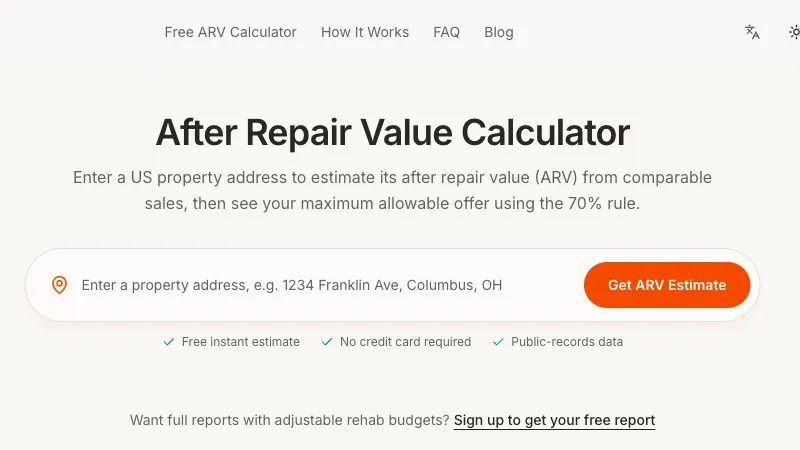
Enter any residential US street address into the free ARV calculator to begin your valuation:
Step 2: Review and Filter Verified Comparable Sales
ARVHQ instantly compiles recent closed transactions from public county records. Each comp displays similarity scores, sold dates, price per square foot, and recorded distances, ensuring your valuation rests on solid data:

You can exclude outliers, fine-tune living area variances, or adjust property condition scores with a single click before finalizing your inputs.
Step 3: Interactive Fine-Tuning and Deal Preview
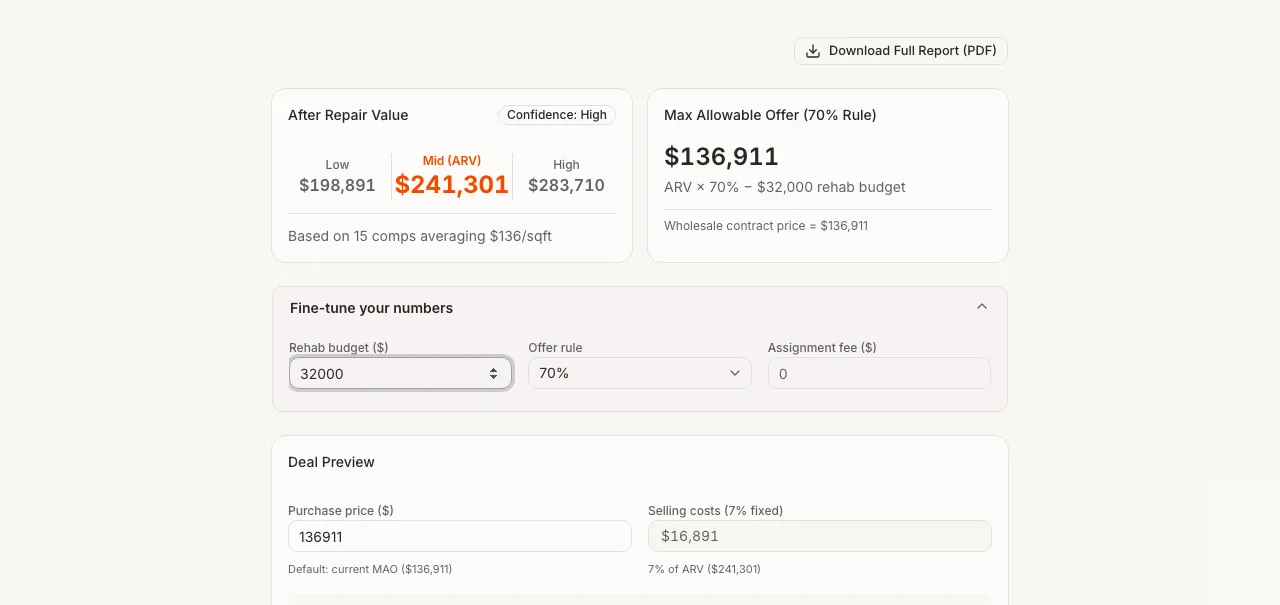
Once comps are aligned, ARVHQ generates your low, mid, and high ARV tiers alongside an automated maximum offer calculation:
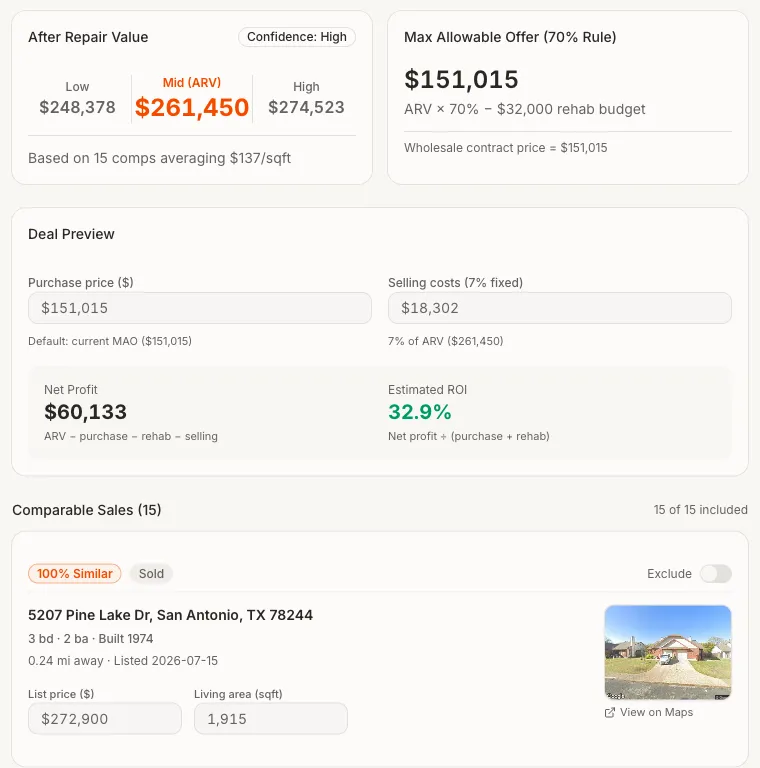
Using the built-in deal sliders, you can adjust your rehab budget, toggle between the standard 70% rule setting, a 75% rule, or custom percentage, and preview your projected net profit and cash-on-cash ROI in real time.
Step 4: Export Defensible Underwriting Reports
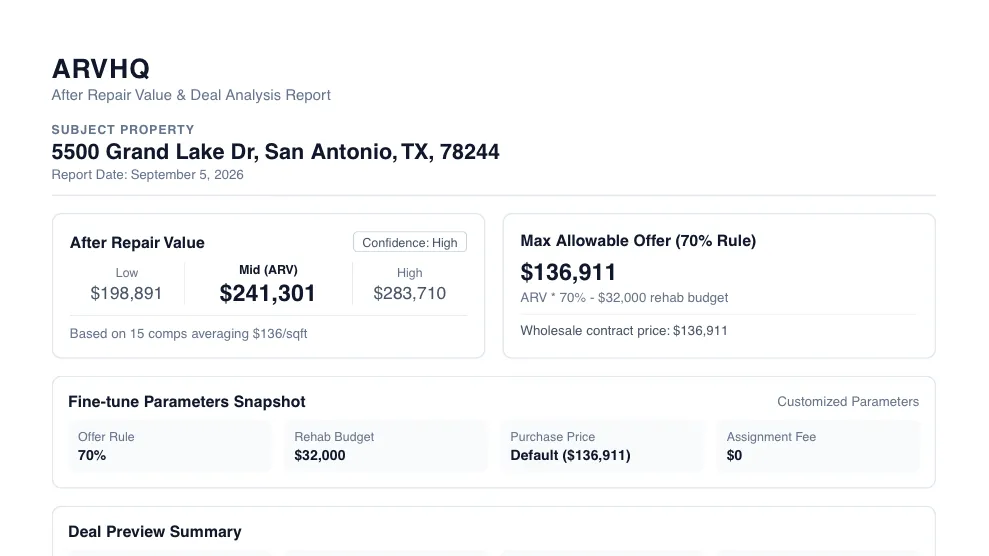
Need to present your underwriting numbers to a private lender, hard money partner, or wholesale buyer? ARVHQ generates clean, downloadable PDF property dossiers:
A note on transparency: ARVHQ is operated by the team behind this article, and its comps come from RentCast's nationwide database of public county-recorded sales — not real-time MLS feeds. Data sources and AI involvement are described on our AI disclosure page. New accounts get three free reports, and for high-stakes deals we always recommend verifying any automated estimate against your own comp check or a licensed appraisal. Utilizing ARVHQ makes applying the formula straightforward and dependable on every deal.
Frequently Asked Questions
Below are direct answers to the most frequent inquiries investors raise regarding the 70 percent rule real estate standard:
What is the 70 rule in house flipping?
The 70 rule in house flipping is a purchase pricing guideline stating that an investor should pay no more than seventy percent of a home's after repair value minus estimated renovation expenses: (ARV × 70%) − Repairs. The remaining thirty percent margin is designed to cover acquisition financing points, debt service, holding costs, property taxes, insurance, resale agent commissions, and your required net profit. In essence, the 70 rule in house flipping establishes a disciplined acquisition ceiling.
Can you use the 70 percent rule for rental properties or BRRRR?
Yes, but the 70 percent rule real estate model should be adjusted to match your refinance terms rather than flip disposition costs. Because BRRRR investors refinance into long-term mortgage debt rather than paying 6% to 8% in retail sales commissions, they typically calibrate their offer ceiling to the takeout lender's maximum loan-to-value threshold, often between 75% and 80% of ARV minus rehab expenses.
Does the 70 percent rule real estate formula include closing costs?
Yes, closing costs are accounted for within the thirty percent spread, but they are not deducted as a separate line item from the formula. In the 70 percent rule real estate framework, the thirty percent discount is specifically calibrated so that transaction expenses—such as title insurance, transfer taxes, recording fees, and retail brokerage commissions—can be paid while still leaving an adequate net profit margin for the investor.
Is the 70 percent rule real estate benchmark still realistic today?
Yes, but only when adapted to local market velocity and price points. In median-priced suburban markets, the 70 percent rule real estate baseline remains the standard benchmark for risk management. In high-cost coastal markets with rapid inventory turnover, investors frequently adjust the multiplier upward to 75% or 80%, whereas in low-priced rural markets or complex gut renovations, the ceiling must be lowered to 60% or 65% to avoid losses.
To screen your next property acquisition against the 70 percent rule real estate formula in seconds, run your address through the free ARV calculator and unlock your first three complimentary valuation reports.