
How to Estimate Rehab Costs: Guide to Repair Budgets
Learn how to estimate rehab costs on house flips and BRRRR deals: square-foot rules, detailed scope of work checklists, and calculating profit margins.

In residential redevelopment, underwriting errors compound exponentially, and learning how to estimate rehab costs is the ultimate prerequisite for profitability, but none destroys investor capital faster than underestimating construction expenses. You can identify the premier neighborhood and negotiate an aggressive discount, yet if your renovation budget runs thirty percent over projection, your anticipated profit dissolves before drywall installation finishes. For house flippers, wholesalers, and rental investors, learning how to estimate rehab costs with precision is the single most vital operational defense against catastrophic project loss.
At its foundation, understanding how to estimate rehab costs is about transforming an unorganized, distressed house into a structured, itemized scope of work. Novices often rely on casual ballpark figures or contractor verbal estimates, only to encounter severe cost overruns when hidden structural issues emerge. Conversely, professional redevelopers evaluate properties systematically by combining square-footage benchmarks during initial screening with granular line-item unit pricing before submitting binding offers. Mastering how to estimate rehab costs ensures that your bids remain competitive while maintaining an unbreakable margin of safety.
This comprehensive guide details exactly how to estimate rehab costs across every phase of residential due diligence. We examine the three tiers of estimating fidelity, break down the core exterior, mechanical, and interior trade packages, explore standard cost-per-square-foot rules of thumb, and demonstrate how to integrate your final construction budget into downstream offer formulas. Before finalizing your bids on distressed properties, establishing an accurate baseline valuation using our free ARV calculator provides the post-renovation context required to budget repairs safely.
TL;DR: How to Estimate Rehab Costs in 30 Seconds
Short on time? Here is the core framework for how to estimate rehab costs on residential investment properties:
- The Three-Tier Estimating Hierarchy: Use square-foot rough estimates ($20 to $100+ per sq ft) for 10-minute deal screening, component-level allowances during physical walk-throughs, and competitive contractor unit-price bids before waiving contingencies.
- The Core Trade Groupings: Structure every budget across three distinct buckets: Exterior Building Envelope (roof, siding, windows, foundation), Mechanical Systems (HVAC, plumbing, electrical panels), and Interior Finishes (kitchen, baths, flooring, paint, trim).
- Non-Negotiable Contingency Cushion: Always allocate a 10% to 20% contingency reserve over your baseline estimate to absorb unseen framing rot, outdated wiring, or permitting delays.
- Integration with Acquisition Ceilings: Your repair estimate directly dictates your maximum bidding price; in rules like the 70 percent rule real estate, every dollar added to rehab subtracts a dollar from your offer.
- Pre-Walkthrough Valuation: Never inspect a job site without first establishing how to calculate ARV from verified neighborhood comps, ensuring you do not over-improve beyond what the local submarket supports.
Rehab Cost Estimating Approaches: Speed vs. Precision
Different stages of deal underwriting require different levels of accuracy. The table below illustrates how to estimate rehab costs using four standard methods, comparing their speed, fidelity, and operational application:
| Estimating Method | Typical Time Required | Accuracy Variance | Best Operational Use | Key Limitation |
|---|---|---|---|---|
| Square-Foot Rule of Thumb | 5 to 10 minutes | ±25% to 35% | Rapid initial desk screening of wholesaler leads | Ignores concentrated mechanical and foundation defects |
| Major Component Pricing | 30 to 45 minutes | ±15% to 20% | On-site initial physical walk-through inspection | Can miss secondary trade items like trim, hardware, or permits |
| Itemized Scope of Work (SOW) | 2 to 4 hours | ±5% to 10% | Binding purchase offer underwriting and hard money approval | Requires trade experience and localized material pricing data |
| Competitive Trade Bids | 3 to 7 business days | ±2% to 5% | Final contractor contracting and contingency release | Too slow to use for fast-moving off-market acquisitions |
The Three Tiers of Learning How to Estimate Rehab Costs
Professional investors do not spend four hours creating a detailed 100-line spreadsheet for every wholesale lead that enters their inbox. Instead, learning how to estimate rehab costs effectively requires matching the estimating tool to your deal stage.
Tier 1: Macro Square-Foot Estimating (Screening Stage)
When evaluating off-market leads over the phone or reviewing online listings, you need a rapid heuristic to decide whether the deal warrants an on-site visit. At this phase, investors categorize properties into four renovation intensities based on finished square footage:
- Cosmetic Refresh ($20 to $35 per sq ft): Flooring replacement (luxury vinyl plank or carpet), full interior paint, updated light fixtures, basic landscaping, and minor cosmetic touch-ups to kitchens and bathrooms.
- Standard Moderate Renovation ($40 to $60 per sq ft): Full interior paint, complete kitchen overhaul (new cabinetry, quartz countertops, modern appliances), full bathroom remodels, new interior doors, partial drywall repairs, and minor mechanical servicing.
- Heavy Gut Renovation ($65 to $85 per sq ft): Complete kitchen and multiple bathroom replacements, total mechanical upgrades (new furnace/AC, water heater, electrical rewiring, PEX re-pipe), new architectural shingle roof, updated vinyl siding, and partial layout reconfiguration.
- Structural Gut / Historical Rebuild ($90 to $125+ per sq ft): Moving load-bearing walls, foundation underpinning, complete framing rebuilding, full exterior envelope reconstruction, lead abatement, and total system replacements.
While the square-foot method is indispensable for initial screening, mastering how to estimate rehab costs requires verifying physical conditions on site before submitting an unconditional purchase contract.
Tier 2: The Physical Walk-Through Component Method
Once a property passes your initial desk review, you must conduct an on-site physical walk-through. At this stage, understanding how to estimate rehab costs involves assigning fixed allowances to major functional components rather than guessing square footage.
When evaluating how to estimate rehab costs during an inspection, carrying a standardized sheet allows you to record conditions room by room. By grouping your assessment into standardized line items (e.g., Roof: $8,500; HVAC: $7,200; Kitchen: $12,000; Bathrooms: $4,500 each), you compile a dependable preliminary budget within 30 minutes.
Tier 3: The Granular Scope of Work (SOW)
The definitive standard for how to estimate rehab costs before closing on an acquisition is compiling a comprehensive Scope of Work. This document itemizes every single trade, labor hour, material finish specification, and permit cost. A comprehensive SOW protects your venture against contractor change orders and serves as the legal exhibit for construction loan draws.
The Investor Walk-Through Checklist: How to Estimate Rehab Costs by Trade Group
When touring a distressed property, novice investors often focus on cosmetic flaws like peeling wallpaper or ugly carpets. Seasoned operators inspect properties from the outside in, prioritizing high-dollar structural and mechanical elements that can break a project budget. Here is how to estimate rehab costs systematically across the three critical trade categories:
1. Exterior Building Envelope
When determining how to estimate rehab costs for the exterior building envelope, addressing deferred maintenance is non-negotiable for appraisal and lender financing:
- Roofing ($6,000 to $14,000): Inspect for curling architectural shingles, missing flashing, sagging ridge boards, or multiple existing layers. Tearing off two layers of old shingles increases disposal fees significantly.
- Siding and Paint ($5,000 to $12,000): Check for wood rot, cracked vinyl panels, or damaged fiber cement. Pre-1978 structures with peeling paint must adhere to strict federal protocols under the EPA Lead Renovation, Repair, and Painting Program, which can add $2,000 to $5,000 in specialized containment and disposal expenses.
- Windows and Exterior Doors ($4,500 to $10,000): Count total openings. Modern vinyl double-hung energy-efficient windows typically cost $450 to $700 per unit installed.
- Foundation and Drainage ($3,000 to $15,000+): Inspect basement walls and crawlspaces for stair-step masonry cracks, horizontal bowing, or standing water. Significant structural foundation repairs require engineered piers and specialized underpinning.
2. Mechanical, Electrical, and Plumbing (MEP)
The most critical phase of how to estimate rehab costs involves auditing mechanical systems. Overlooking mechanical defects is how novice budgets fail:
- HVAC Systems ($6,500 to $11,000): Check the manufacturer tag for age. Units older than 15 years operating on phased-out refrigerants warrant full replacement. Installing a complete split heat pump system with ductwork in older homes lacking central air can exceed $12,000.
- Electrical Infrastructure ($3,500 to $10,000): Inspect the main service panel. Outdated 60-amp or 100-amp fuse boxes, obsolete Zinsco or Federal Pacific panels, or cloth-insulated wiring must be upgraded to modern 200-amp breakers. All on-site job operations must meet safety standards detailed in OSHA Residential Construction regulations.
- Plumbing and Water Heaters ($4,000 to $12,000): Galvanized steel supply pipes corrode internally, restricting pressure and demanding replacement with modern PEX piping. Cast-iron sewer waste lines often require hydro-jetting, trenchless lining, or full excavation.
Federal economic tracking provided by the U.S. Census Bureau Construction Spending reports highlights that mechanical and structural labor expenses consistently escalate faster than general consumer inflation, underscoring why investors must verify trade rates locally.
3. Interior Living Spaces and Finishes
Understanding how to estimate rehab costs for interior living spaces requires balancing tenant appeal and buyer valuation against prevailing neighborhood comps:
- Kitchen Renovations ($8,000 to $25,000): A moderate flip kitchen requires new shaker-style all-wood cabinets ($4,500 to $9,000), pre-fabricated quartz or granite countertops ($2,200 to $4,500), stainless steel appliance packages ($2,500 to $4,500), and tile backsplashes with undermount sinks ($1,200 to $2,000).
- Bathroom Remodels ($3,500 to $8,500 per bath): Complete bathroom overhauls entail new tubs or walk-in tile showers, modern vanities, water-saving toilets, modern plumbing trim kits, and waterproof floor tiling.
- Flooring ($3.50 to $7.00 per sq ft installed): Luxury vinyl plank (LVP) remains the industry gold standard for rental and entry-level flip properties due to its durability and water resistance. Hardwood refinishing runs $3.00 to $5.50 per square foot.
- Interior Paint and Drywall ($4,000 to $9,000): Professional two-tone spray and back-roll painting (agreeable gray or modern white with crisp semi-gloss trim) instantly rejuvenates tired interiors.
- Tax and Accounting Treatment: Remember that when renovating rental holdings, distinguishing between deductible immediate maintenance and capitalized improvements requiring 27.5-year depreciation schedules must follow IRS Publication 527.
How to Calculate Rehab Costs: Step-by-Step Mathematical Walkthrough
To see how to estimate rehab costs in practice, let us examine an itemized calculation for a 1,750-square-foot 3-bedroom, 2-bathroom ranch home built in 1974:
1. Exterior Trade Items
- Tear-off and replacement of 22 squares of architectural shingles: $7,700
- Repairing damaged soffits and painting exterior siding: $4,200
- Replacing 12 drafty windows with vinyl energy-efficient units: $6,600
- Minor masonry pointing and front porch handrail repair: $1,200
- Exterior Subtotal: $19,700
2. Mechanical Systems
- Upgrading obsolete 100-amp fuse box to 200-amp panel: $3,200
- Replacing 18-year-old gas furnace and condensing unit (3-ton split): $7,800
- Replacing leaking 40-gallon atmospheric gas water heater: $1,600
- Partial PEX re-plumbing of accessible crawlspace supply lines: $2,800
- Mechanical Subtotal: $15,400
3. Interior Finishes
- Complete kitchen remodel (shaker cabinets, quartz counters, stainless appliances): $13,500
- Primary bathroom gut renovation (tile surround, new vanity, toilet, fixtures): $5,800
- Guest bathroom cosmetic update (new vanity, mirror, hardware, reglaze tub): $2,400
- Installing 1,500 sq ft of waterproof luxury vinyl plank flooring: $6,750
- Interior drywall patching and whole-house paint (walls, ceilings, trim, doors): $5,200
- New brushed nickel interior door hardware and LED recessed lighting package: $2,100
- Interior Subtotal: $35,750
4. General Conditions, Permits, and Contingency Reserve
- Dumpster rentals (three 30-yard roll-off containers) and continuous job clean-up: $2,100
- Municipal building, electrical, and plumbing permit fees: $1,400
- Baseline Construction Subtotal: $74,350
- Contingency Reserve (15%): $11,150
- Total Estimated Rehab Cost: $85,500
Dividing the $85,500 final budget by 1,750 square feet yields an all-in renovation rate of approximately $48.86 per square foot, confirming that this project sits comfortably within the moderate renovation tier.
Common Hidden Pitfalls When Estimating Repair Costs for House Flipping
Even seasoned operators occasionally encounter budget surprises. Learning how to estimate rehab costs with institutional discipline requires anticipating unseen conditions before demolition commences:
- Permit Backlogs and Municipal Requirements: Municipalities often mandate unexpected upgrades once you pull a permit, such as installing hardwired smoke/CO detectors in every bedroom, replacing sewer laterals to the city main, or elevating railings to meet updated building codes.
- Subfloor Rot and Termite Damage: Tile floors or thick carpets frequently conceal rotting plywood subfloors around bathtubs, toilets, and exterior doorways. Discovering damaged joists adds thousands in structural carpentry.
- Unpermitted Prior Additions: If a prior homeowner enclosed a garage or patio without permits, local inspectors may require total demolition or retrospective engineering drawings.
- Scope Creep: Expanding the scope of work mid-project (e.g., deciding to build custom walk-in closets or install expensive landscaping) erodes your net profit margin.
Connecting How to Estimate Rehab Costs to Acquisition Offers
Mastering how to estimate rehab costs is not an academic exercise; its primary purpose is establishing an unassailable acquisition ceiling. In residential underwriting, renovation budgets feed directly into maximum offer equations:
Integration with the 70% Rule
Under the classic house flipping formula, your purchase ceiling is defined as:
Maximum Purchase Price = (ARV × 70%) − Estimated Rehab Costs
If a property boasts a verified post-renovation market valuation of $300,000, seventy percent equates to $210,000. If your detailed estimate establishes a rehab budget of $55,000, your absolute maximum offer is $155,000 ($210,000 − $55,000). If unexpected walk-through findings push that repair budget to $75,000, your offer ceiling must drop immediately to $135,000 to preserve your required equity cushion.
To review the detailed accounting spread behind this equation, explore our comprehensive breakdown of the 70 percent rule real estate.
Integration with Bottom-Up MAO Calculations
Wholesalers and institutional redevelopers utilize bottom-up underwriting formulas that calculate exact holding costs, transaction expenses, and required dollar returns rather than relying on flat percentage discounts.
In these underwriting models, every line item must balance. Knowing how to estimate rehab costs accurately prevents submitting unnecessarily low offers that sellers reject or winning unprofitable deals through underestimation. For a complete guide to structuring acquisition bids, review our walkthrough on max allowable offer real estate.
Crucially, your repair estimate must always align with local sales comparables. If comparable renovated properties in the neighborhood feature laminate countertops, installing imported marble will not yield higher appraisal adjustments under the Fannie Mae adjustments framework. You must study closed transactions adhering to Fannie Mae Comparable Sales guidelines to identify the finish baseline of the submarket. To refine your comp selection process, review our guide on how to find comps in real estate.
How to Estimate Rehab Costs Using ARVHQ
Eliminating manual spreadsheet errors gives investors an enormous edge. ARVHQ integrates market comps with deal analysis, demonstrating how to estimate rehab costs and calibrate maximum purchase prices in seconds.
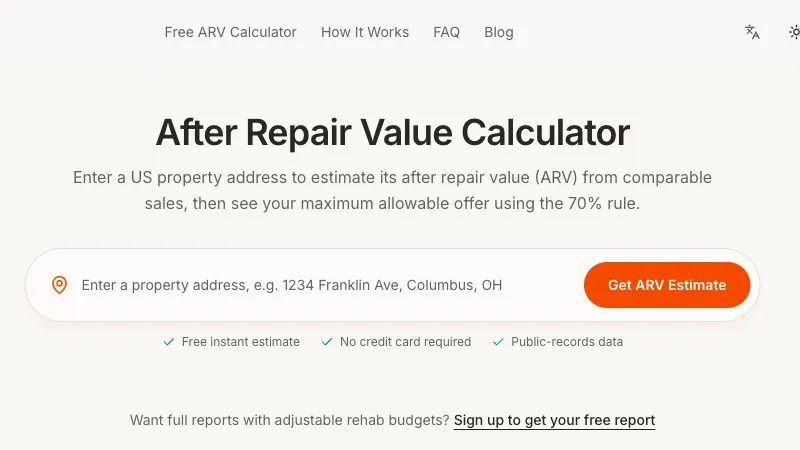
Step 1: Input Subject Property Address
Enter the target street address into the free ARV calculator to retrieve county-recorded property specifications, establishing the foundation for how to estimate rehab costs against market comps:
Step 2: Calibrate Neighborhood Comps
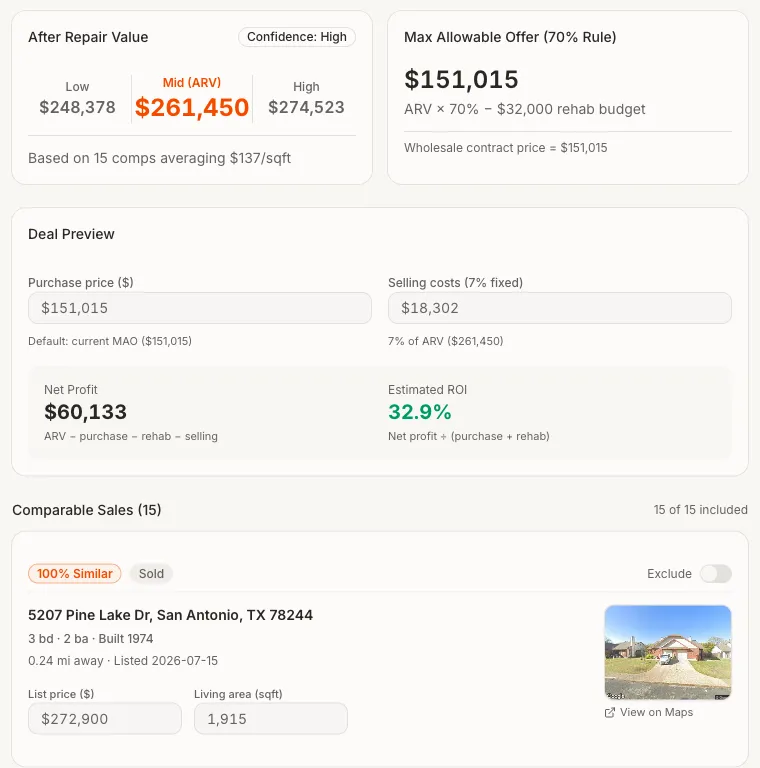
Review recent closed transactions pulled directly from public county records. Filter out non-arm's-length transfers and examine sale dates, distances, and living area adjustments to establish an unassailable post-renovation valuation benchmark:

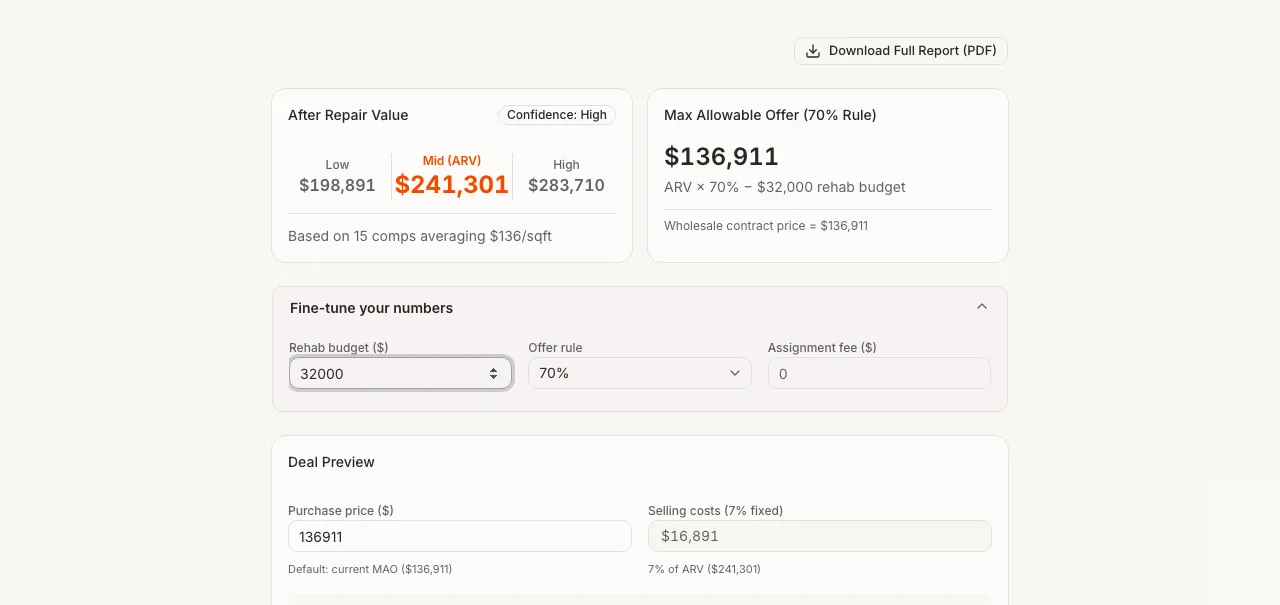
Step 3: Input Renovation Numbers and Review Offer Tiers
Seeing how to estimate rehab costs alongside interactive deal calculation sliders accelerates deal analysis. The tool instantly recalculates your Maximum Allowable Offer, projected net profit, and return on investment across conservative, median, and aggressive market valuation tiers:
Experiment with custom percentage sliders to see how shifting your repair budget affects your acquisition ceiling in real time:
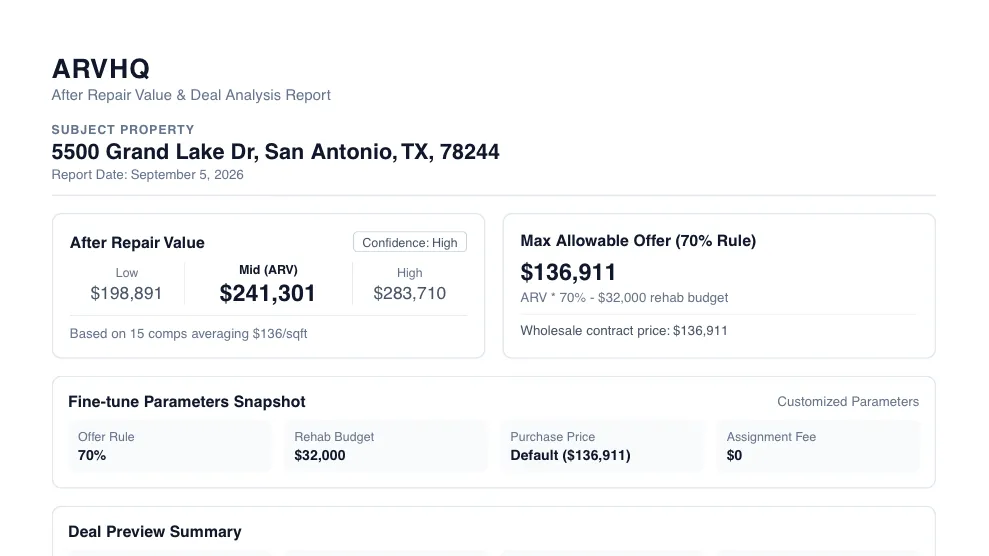
Step 4: Generate Professional Deal Dossiers
Presenting clear underwriting documentation to private lenders, hard money underwriters, and seller partners creates instant institutional credibility. Export a comprehensive deal dossier complete with comp adjustments and repair assumptions:
A note on transparency: ARVHQ is operated by the team behind this article, and its comps come from RentCast's nationwide database of public county-recorded sales — not real-time MLS feeds. Data sources and AI involvement are described on our AI disclosure page. New accounts get three free reports, and for high-stakes deals we always recommend verifying any automated estimate against your own comp check or a licensed appraisal. Utilizing ARVHQ makes learning how to estimate rehab costs and submitting disciplined offers fast and dependable.
Frequently Asked Questions
How do investors quickly estimate rehab costs on a walk-through?
Investors quickly learn how to estimate rehab costs on a walk-through by applying component-level pricing allowances across major building systems rather than guessing square footage. By evaluating the roof, HVAC, electrical service panel, plumbing lines, kitchen, and bathrooms against a standardized price matrix, an investor can compile an accurate preliminary budget within 30 minutes. Adding a 15% contingency cushion ensures that unanticipated structural issues discovered during demolition do not jeopardize project profitability.
What are the most common hidden rehab costs in flips?
When evaluating how to estimate rehab costs on older homes, the most common hidden expenses are concealed water damage, outdated electrical infrastructure, unpermitted prior renovations, and municipal permit delays. Subfloor rot beneath showers and toilets, hazardous cloth-insulated or aluminum wiring inside walls, sewer line root intrusion, and city requirements to bring unrelated systems up to current building codes represent the frequent unexpected line items that inflate project expenses beyond initial expectations.
How much should I allocate for a renovation contingency reserve?
You should allocate a 10% to 20% contingency reserve over your baseline construction estimate on every residential redevelopment project. Understanding how to estimate rehab costs responsibly means budgeting a 10% reserve for cosmetic updates where mechanical systems remain untouched. For older homes built prior to 1980 or substantial structural renovations where plumbing, electrical, and framing elements are disturbed, establishing a 15% to 20% contingency is mandatory to absorb unforeseen field variances.
How does rehab cost impact maximum allowable offer calculations?
Rehab cost impacts maximum allowable offer calculations by acting as a direct dollar-for-dollar reduction of your purchase ceiling: every dollar added to your repair budget reduces your maximum acquisition price by exactly one dollar. In standard formulas like the 70 percent rule, the equation deducts estimated repair costs directly from the discounted after repair value, ensuring that construction expenses never erode the investor's target net profit margin or financing buffer.