
How to Find Comps in Real Estate: Step-by-Step Guide for Investors
Learn how to find comps in real estate step by step: the five criteria of a valid comp, free sources for sold data, and turning comps into ARV and a max offer.
If you are fixing and flipping, wholesaling, or simply deciding what to offer on a property, comparable sales — comps — are the evidence behind every number on your spreadsheet. Learning how to find comps in real estate is one of the highest-leverage skills an investor can build, because the comps you choose directly shape your after repair value (ARV), your maximum allowable offer, and ultimately your profit margin.
The good news: the process is learnable in an afternoon and does not require a license, an MLS login, or a paid data subscription. This guide walks through the six steps, the five criteria that separate a valid comp from noise, and the exact math that turns a shortlist of sold homes into a defensible offer.
Quick Answer: How to Find Comps in Real Estate
Short on time? Here is the whole method in five lines:
- Pull recent sold homes — not active or pending listings — near your subject property.
- Keep sales that closed within the last three to six months and sit within roughly a mile of the subject (tighter in dense city neighborhoods, wider in rural areas).
- Filter for true matches: same property type, similar bed and bath count, square footage, and condition.
- Adjust each comp up or down for its differences from the subject, then average the adjusted prices to estimate ARV.
- On a flip, apply the 70% rule — ARV times 70%, minus your rehab budget — to set a maximum offer. Or skip the manual work of how to find comps in real estate and run the pull automatically — comps, an ARV estimate, and a max offer from a single address.
What Comps Are — and Why They Decide Your Offer
A comp is a recently sold home that closely resembles the property you are evaluating. Appraisers use them to justify a value a lender will accept, agents use them to price listings, and investors use them to estimate ARV — what the property should sell for after renovations are complete.
The key word in that definition is sold. An asking price is a seller's opinion; a sold price is a fact the market actually paid. That is why every serious method for how to find comps in real estate starts with closed sales, not active listings — and why a comp list built from asking prices falls apart the moment an appraiser looks at it.
The Five Criteria of a Valid Comp
Every guide on how to find comps in real estate eventually comes down to the same five filters. Apply them in order and you will reject most of the raw sales you pull — that is the point:
| Criterion | Rule of thumb | Why it matters |
|---|---|---|
| Status | Sold and closed — never pending or active | Asking prices are opinions; sold prices are what buyers actually paid |
| Recency | Closed within the last three to six months | Older sales stop reflecting current market conditions |
| Distance | Within about a mile; tighter in urban cores, wider in rural areas | Buyers shop by neighborhood, not by city limits |
| Physical fit | Same property type, similar beds, baths, and square footage | A four-bedroom comp tells you little about a two-bedroom subject |
| Condition | Similar renovation level to your subject — as-is or as-completed | A fully renovated comp will overstate the value of a dated property |
How to Find Comps in Real Estate, Step by Step
Step 1: Profile Your Subject Property
How to find comps in real estate starts before you open a single website: write down your subject's profile. Beds, baths, above-grade square footage, lot size, property type (single-family, condo, townhome), and an honest condition grade — dated, average, or renovated. Every filter you apply later hangs off this profile, and an honest condition note now saves you from an inflated ARV later.
Step 2: Pull Sold Sales from Free Sources
With the profile in hand, here is where how to find comps in real estate gets practical — three places to pull sold data:
- County records. Most county recorder or assessor websites let you search recorded deeds and sale amounts for free. This is the raw source — public recorded sales — and it is the same class of data that paid platforms license and resell.
- Free listing portals. Major listing platforms provide a "sold" filter where you can map recent closed sales around an address and see sale dates and prices.
- An agent or appraiser. If you work with one, they can pull an MLS-backed comparative market analysis (CMA), which is the cleanest sold-data set available.
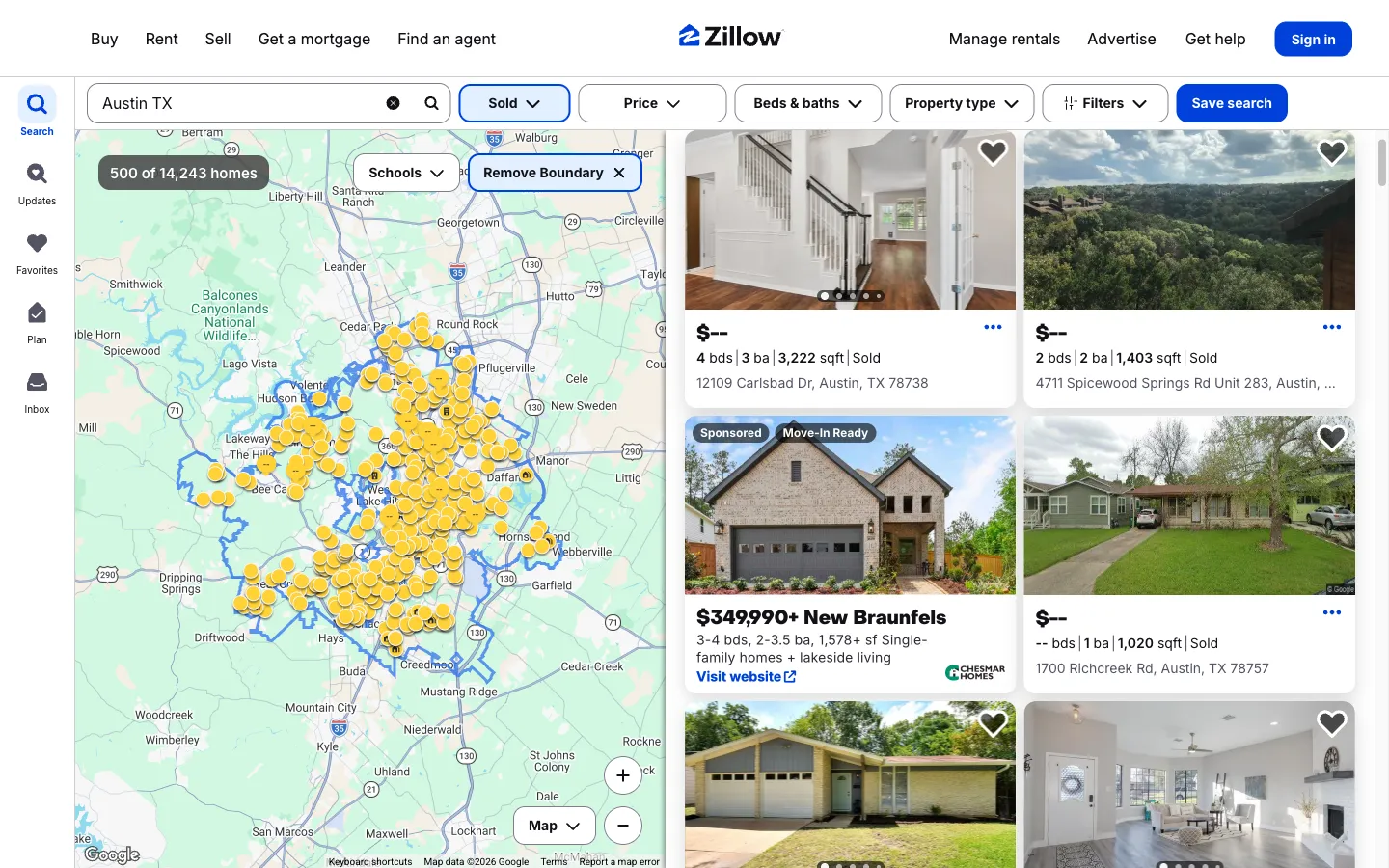
On the free portals, the "sold" filter is the switch that turns opinions into evidence. Here is Zillow's Austin search narrowed to recently sold homes — 14,243 closed transactions, with sold dates and prices on every card:
Redfin works the same way — filter to sold homes in the last three months and the map dots show exactly where the market actually cleared, street by street:

Step 3: Filter Down to Three to Five True Comps
Raw pulls usually return a dozen or more sales; your job is to shrink that list using the five criteria above. Three to five tight comps beat ten loose ones — the tighter your filter, the less your adjustments have to guess. If you cannot find three solid matches within a mile and six months, widen distance slightly before you widen recency, and drop comps that fail the property-type or condition test no matter how close they are. This filtering discipline is the difference between knowing how to find comps in real estate and merely finding nearby addresses.
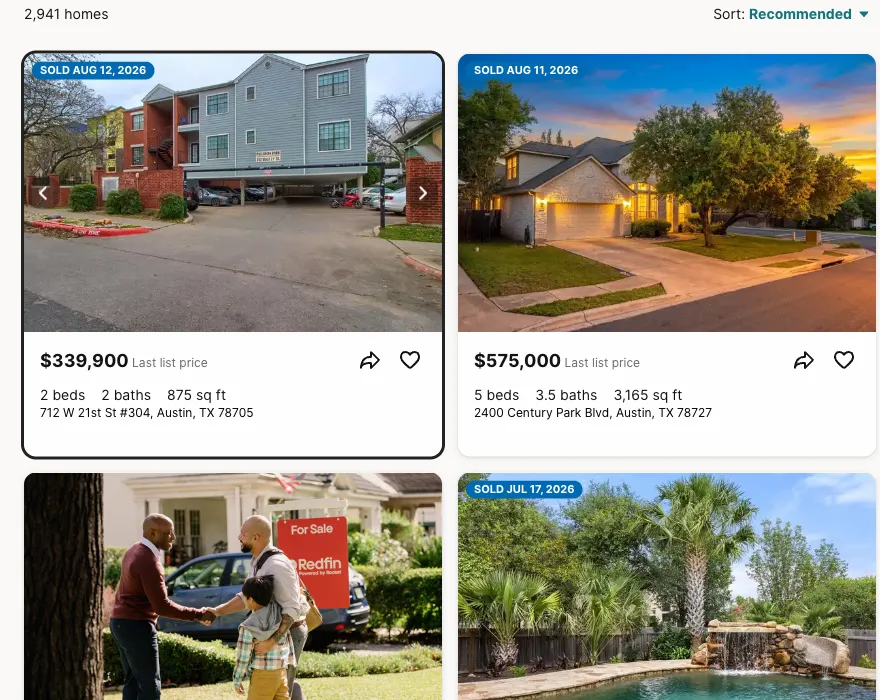
A valid comp line looks like this: sold date, last list price, beds and baths, square footage, and the exact address — everything you need to judge physical fit at a glance:
Step 4: Adjust Each Comp for Its Differences
No comp is a perfect twin, so every honest method for how to find comps in real estate includes an adjustment pass. If a comp has an extra bedroom, a finished basement, or a renovated kitchen your subject will not have after rehab, adjust that comp's price downward; if your subject is superior, adjust upward. Price per square foot is useful as a sanity band — if your adjusted values drift far outside the neighborhood's typical range, recheck your work — but treat it as a checkpoint rather than a formula, because the second bathroom and the tenth square foot are not worth the same. Write down every adjustment and the reason for it; that notes file is what turns a guess into a defensible estimate.
Step 5: Convert Comps into an ARV and a Maximum Offer
This is where how to find comps in real estate pays off: average your adjusted comp values to get the ARV. Then, if you are buying a flip, apply the 70% rule — the long-standing investor rule of thumb that says your maximum allowable offer (MAO) should be 70% of ARV minus the repair budget, which builds in holding costs, selling costs, and profit.
Here is an illustrative example with rounded numbers — not a real transaction: say six adjusted comps point to an ARV of about $247,500, and you estimate repairs at $42,000. The 70% rule works out to $247,500 × 70% = $173,250, minus $42,000 in rehab, for a maximum offer of about $131,250. If your profit requirement or local market risk is different, you can flex the percentage — but always derive the offer from the comps, never from hope.
Step 6: Reality-Check Before You Offer
The last mile of how to find comps in real estate is verification, and it happens offline. Drive the comp properties: photos hide busy roads, and records do not show which "renovated" comp was actually a cheap cosmetic flip. Check whether sales involved unusual concessions or non-arm's-length transfers (family sales, foreclosures) that distort the price. When the deal size justifies it, pay for an appraisal or ask an agent to sanity-check your comp set before your offer goes in.
Tips and Mistakes That Skew Your Numbers
Once you know how to find comps in real estate, keep your estimates honest with these habits:
- Use sold, not active. Active listings tell you what sellers hope; only closed sales are evidence — it is the first rule of how to find comps in real estate.
- Mind the season. A comp from the winter in a seasonal market may not reflect a spring sale — favor the most recent closed sales you can find.
- Watch concessions. A sale price with a large seller-paid closing-cost credit is effectively lower than it looks on the record.
- Keep a comp log. Save every comp you used, the adjustments you made, and why — you will re-use the format on every future deal.
Most bad advice on how to find comps in real estate makes one of these mistakes: pricing from asking prices, borrowing a renovated comp for a dated subject, using family transfers or foreclosure sales as if they were normal market sales, and assuming your ARV is guaranteed to match a future appraisal. Appraisers can and do disagree with investor comp sets — which is exactly why Step 6 exists.
How to Automate the Comp Pull
Doing the pull by hand at least a few times is worth it, because knowing how to find comps in real estate manually also makes you a sharp judge of any automated report. When you are ready to speed up, ARVHQ does the heavy lifting: enter an address, and it gathers comparable sales, adjusts for differences, and returns an ARV estimate together with a max-offer figure in one report.
A note on transparency: ARVHQ is operated by the team behind this article, and its comps come from RentCast's nationwide database of county-recorded sales — public recorded transactions, not real-time MLS feeds. Data sources and AI involvement are described on our AI disclosure page. New accounts get three free reports, and we always recommend verifying any automated estimate against your own comp check on larger deals. You can try it on the ARV calculator.
The whole workflow collapses into one input box — type an address, hit Calculate ARV:

Behind the form, the tool documents exactly how it defines ARV and which local comps feed the estimate, so you can sanity-check the numbers instead of trusting a black box:

Frequently Asked Questions
Related questions on how to find comps in real estate, answered: ### How can I look up real estate comps? Search your county recorder or assessor site for recorded sale deeds, or use the "sold" filter on a portal like Zillow or Redfin to map closed sales around your subject address. Then narrow the results with the five comp criteria above — they are the backbone of how to find comps in real estate: status, recency, distance, physical fit, and condition. ### How do realtors find comps? Realtors typically pull comps from the MLS, where sold data is cleanest, and package them into a comparative market analysis (CMA) with adjustments for differences between the comps and the subject property. Appraisers work from the same sold-data principle, which is why a well-built investor comp set can stand up to an appraisal review. ### Can I pull comps myself? Yes. Sold sale records are public in most counties, and free portals expose recent closed sales on a map — that is the core of how to find comps in real estate — so a careful investor can build a reliable comp set without paying for data. The trade-off is time and discipline — you have to filter and adjust the comps yourself, and verify anything unusual in the records. That is how to find comps in real estate: profile the subject, pull sold data, filter hard, adjust honestly, and convert the numbers into an offer you can defend. When you want the pull done in seconds instead of an afternoon, run your address through the ARV calculator and start with the three free reports.