
BRRRR Strategy in Real Estate: Formula, Steps, Comps
Master the BRRRR strategy in real estate: buy, rehab, rent, refinance, and repeat. Learn how post-renovation ARV and comps enable 100% capital recycling.

In residential wealth building, the ultimate constraint on portfolio growth is capital exhaustion: once you deploy your savings into a down payment, your acquisition pipeline halts until you save again. To overcome this limitation, experienced property investors utilize the BRRRR strategy. Standing for Buy, Rehab, Rent, Refinance, Repeat, the BRRRR strategy transforms static real estate purchases into dynamic, self-funding capital recycling machines. Rather than locking liquidity permanently inside single-family rentals, this investment framework recovers your original capital through post-renovation equity creation.
At its operational core, the BRRRR strategy relies on forced appreciation to unlock institutional mortgage liquidity. An investor acquires an undervalued, distressed asset below retail value, manages a targeted renovation to maximize livability, leases the unit to qualified tenants at market rents, and then executes a cash-out refinance based on an appraiser's updated valuation. By executing the BRRRR strategy systematically, you establish a resilient rental portfolio while recycling the exact same pool of investment capital across multiple transactions.
However, executing a seamless BRRRR strategy requires far more than casual optimism; it demands institutional rigor during the underwriting and appraisal phases. If you overestimate your post-repair valuation or miscalculate contractor bids, equity remains trapped in the property, interrupting your velocity of capital. Understanding how the BRRRR strategy functions across varying asset tiers and lending environments is critical to building lasting net worth. For investors evaluating purchase thresholds, analyzing your underlying target using a free ARV calculator provides the foundational margin of safety before making an acquisition offer.
TL;DR: The BRRRR Strategy in 30 Seconds
Short on time? Here is how the BRRRR strategy operates in modern residential investing:
- The Five-Stage Lifecycle: Acquire distressed properties at steep discounts (Buy), execute high-ROI value-add renovations (Rehab), stabilize with vetted tenants (Rent), extract equity via a cash-out loan (Refinance), and redeploy that recycled liquidity into your next asset (Repeat).
- The Core Formula Target: Total Investment (Purchase Price + Rehab Costs + Carrying Expenses) must remain at or below the maximum loan-to-value (LTV) percentage of your takeout lender, typically 70% to 75% of after repair value.
- Why It Differs from Flipping: In a flip, you incur retail disposition brokerage fees (6% to 8%) and pay short-term capital gains taxes; in the BRRRR strategy, long-term rental income services permanent debt while you defer taxes and retain appreciating real estate.
- The Decisive Fulcrum: Your refinance proceeds hinge entirely on the independent appraiser's valuation; you must first master how to calculate ARV using defensible, closed neighborhood comps.
- Downside Risk Control: If appraisal values come in low or market rents soften, capital remains stuck in the deal, turning an intended zero-cash-left transaction into a conventional rental with capital left behind.
How the BRRRR Strategy Compares to Alternative Investment Models
Different real estate strategies serve distinct financial objectives. The table below details how the BRRRR strategy compares against traditional flipping, turnkey rentals, and wholesaling:
| Investment Model | Primary Goal | Capital Requirement | Holding Timeline | Tax Profile | Core Operational Risk |
|---|---|---|---|---|---|
| BRRRR Strategy | Infinite capital velocity and recurring rental cash flow | Medium (recycled repeatedly across multiple deals) | Indefinite (long-term buy-and-hold portfolio) | Favorable (tax-deferred cash-out, depreciation, interest deduction) | Appraisal shortfall trapping cash; construction cost inflation |
| Traditional House Flipping | Lump-sum cash generation via retail disposition | Medium to High (re-invested per project) | Short (3 to 6 months per transaction) | Unfavorable (ordinary income or short-term capital gains tax rates) | Market price softening during rehab; holding cost escalation |
| Turnkey Rental Property | Passive, immediate rental income with zero sweat equity | High (unrecoverable 20% to 25% down payments per door) | Indefinite (passive asset accumulation) | Favorable (standard passive rental depreciation shelter) | Minimal built-in equity cushion; lower cash-on-cash returns |
| Real Estate Wholesaling | Upfront transaction fee generation without taking title | Very Low (earnest money deposit only) | Ultra-short (1 to 30 days contract assignment) | Unfavorable (active business income taxed at ordinary brackets) | Inability to assign contract to viable cash buyers before deadline |
What Is the BRRRR Strategy?
The BRRRR strategy is a cyclical investment methodology designed to scale a rental housing portfolio with finite starting capital. Rather than saving up successive 20% down payments over years of personal labor, the BRRRR strategy utilizes the compounding power of forced equity. When you buy a distressed house, renovate it efficiently, and rent it to solid tenants, you transform a substandard property into an institutional-grade performing rental asset.
To understand why the BRRRR strategy has generated immense private wealth, consider the velocity of capital. When an investor purchases a turnkey rental for $250,000 with 20% down ($50,000), that money sits permanently illiquid inside that single property. Acquiring ten such properties requires saving $500,000 in liquid capital. Conversely, by deploying the BRRRR strategy, an investor uses that initial $50,000 to purchase a distressed property for $140,000, funds a $35,000 renovation using short-term private or hard money financing, increases the value to $250,000, and refinances at 75% LTV ($187,500). That refinance completely repays the initial capital, leaving zero net dollars trapped while adding a cash-flowing asset to the balance sheet. The investor then takes that same $50,000 and repeats the process.
However, the BRRRR strategy only succeeds when each sequential link in the chain is executed with disciplined underwriting. A mistake during any phase directly threatens the solvency of the entire venture.
The BRRRR Method Formula and Underwriting Mechanics
Underwriting a successful BRRRR strategy deal requires working backward from your exit financing. Unlike retail buyers who focus on current list prices, BRRRR practitioners evaluate acquisitions through the lens of institutional takeout lenders.
The mathematical baseline of the BRRRR method formula is:
Maximum Total Investment = Appraised After Repair Value (ARV) × Takeout Lender Maximum LTV
Where:
Total Investment = Purchase Price + Renovation Costs + Holding Costs + Refinance Closing Costs
To achieve a "perfect BRRRR" where one hundred percent of your capital is returned upon refinancing, your total capital expenditure cannot exceed your refinance loan amount. Consider the standard underwriting variables:
- Target Takeout LTV: Most conventional Fannie Mae or commercial DSCR lenders offer cash-out refinance loans up to 70% or 75% of the appraised value for single-family residential properties, as codified under Fannie Mae Cash-Out Refinance guidelines. Some credit unions and portfolio lenders may extend terms up to 80% LTV under specific seasoning parameters.
- Carrying and Financing Costs: During the 3 to 6 months required to renovate and lease the property, you must pay monthly interest on your short-term debt, property taxes, builder's risk insurance, and utility charges.
- Refinance Friction: Cash-out mortgage originations carry loan underwriting fees, title insurance, closing attorney charges, and appraisal fees, typically amounting to 2% to 3% of the new loan amount.
To understand the difference between this model and fixed-margin flips, compare this framework against the traditional 70 percent rule real estate. In flipping, the formula caps purchase prices at 70% of ARV minus repairs because 6% to 8% is lost to retail realtor commissions, title transfer stamps, and buyer concessions at sale. In the BRRRR strategy, because you retain ownership and refinance rather than sell, you avoid retail disposition costs entirely. Instead, total capital recovery is governed strictly by your takeout financing: to recover 100% of your invested capital, your Total Investment (purchase price plus renovation, holding, and refinance closing costs) cannot exceed your lender's maximum cash-out loan limit (typically ARV × 75%). Consequently, your maximum allowable purchase price equals ARV × 75% minus all renovation, holding, and refinance expenses.
Executing the 5 Steps of the BRRRR Strategy
Executing the BRRRR strategy successfully demands flawless orchestration across five distinct operational phases.
Step 1: Buy (Acquisition at a True Discount)
The entire success of the BRRRR strategy is determined on the day you sign the purchase contract. If you pay too much for the property, no amount of brilliant renovation or clever financing will extract your initial capital.
Target acquisitions for the BRRRR strategy typically exhibit significant cosmetic neglect or functional obsolescence: outdated kitchens, aging mechanical systems, worn flooring, or deferred exterior maintenance. To secure these off-market opportunities, investors leverage direct mail, wholesaler networks, probate filings, foreclosure lists, and relationships with local real estate agents who understand distressed inventory.
Crucially, you must verify your projected post-repair valuation before making an offer. An investor must study closed neighborhood comps matching the target property in age, square footage, architectural style, and finish level. Review our step-by-step framework on how to find comps in real estate to eliminate subjectivity from your comp screening.
Step 2: Rehab (Strategic Value-Add Renovations)
In the BRRRR strategy, your renovation goal is not personal luxury; it is maximizing appraisal valuation and tenant durability per dollar spent. Every expenditure must generate a measurable return on investment during the refinance appraisal.
Key value-add renovation priorities include:
- Modernized Kitchens and Bathrooms: Installing durable shaker cabinetry, quartz or granite countertops, modern undermount sinks, and contemporary tile surrounds.
- Adding Legal Bedrooms or Bathrooms: Converting unutilized footprint, such as formal dining rooms or oversized basements, into code-compliant bedrooms with proper egress windows and closets drastically increases appraisal comps.
- Durable Flooring and Fixtures: Replacing worn carpeting with high-grade luxury vinyl plank (LVP) flooring, which resists moisture, simplifies tenant turnover, and commands premium rental rates.
- Major Systems Overhauls: Servicing or replacing aging HVAC units, water heaters, and electrical panels ensures long-term operational reliability. Proper maintenance vs. capital asset distinction must be documented according to IRS Publication 527 for depreciation and deduction schedules.
Avoid over-improving beyond prevailing neighborhood standards. Installing $15,000 commercial appliances in a working-class rental submarket will not increase appraised value proportionally, resulting in wasted equity.
Step 3: Rent (Securing High-Quality Tenants)
A newly renovated property cannot be refinanced until it is occupied by qualified tenants who have executed a binding lease agreement. Takeout lenders require an executed lease and proof of security deposit collection to document the asset's debt-service ability.
Screening tenants effectively is essential to protecting your physical asset and ensuring stable cash flow:
- Credit and Background Checks: Verify payment history, court records, and credit scores through nationwide screening bureaus.
- Income Verification: Require gross household monthly income of at least 2.5 to 3 times the monthly rental rate.
- Landlord References: Contact previous property managers rather than current landlords to obtain candid feedback on tenant reliability and property care.
- Market-Rate Pricing: Set rental rates at fair market value using localized rental comp tools. Overpricing leads to prolonged vacancy, generating unnecessary holding costs that deplete your working reserves.
Step 4: Refinance (Extracting Capital via Cash-Out Debt)
The refinance phase represents the financial climax of the BRRRR strategy. Once the property is renovated and leased, you replace your short-term acquisition debt (hard money or private funds) with long-term, low-interest permanent financing.
Navigating the cash-out refinance requires understanding critical underwriting hurdles:
- Seasoning Periods: Most conventional lenders following Freddie Mac Special Purpose Cash-Out Refinance Mortgages guidelines enforce a seasoning period—typically 6 to 12 months from original purchase date—before they allow an appraisal based on the new market value rather than the original purchase price plus documented improvements. However, specialized commercial DSCR (Debt Service Coverage Ratio) lenders often refinance after only 90 days of lease seasoning.
- Debt Service Coverage Ratio (DSCR): Commercial lenders evaluate the property's gross rental income against total monthly principal, interest, taxes, insurance, and HOA dues (PITIA). A minimum DSCR of 1.20x to 1.25x is typically required to approve financing.
- The Independent Appraisal: The lender dispatches an independent licensed appraiser to determine the current market value. Lenders mandate compliance with the Fannie Mae Comparable Sales guidelines, requiring verified arm's-length closed transactions. The appraiser will adjust your valuation based on lot size, bedroom count, and verified condition ratings under the Fannie Mae adjustments framework.
- Macro Interest Rate Movements: Debt service costs depend heavily on macroeconomic conditions. When central bank interest rate benchmarks shift, as documented in the Federal Reserve Selected Interest Rates table, monthly mortgage payments adjust accordingly, altering your net cash flow margins and borrowing capacity.
- Cash Extraction: At closing, the new mortgage pays off your temporary acquisition loan and reimburses your renovation budget, transferring cash back into your operating bank account tax-free, as cash-out loan proceeds represent borrowed debt rather than taxable profit.
Step 5: Repeat (Portfolio Compounding and Velocity)
With your initial capital safely returned to your liquid reserves, you are ready to repeat the cycle. The true magic of the BRRRR strategy lies in its exponential compounding effect.
If you start with $60,000, executing one traditional 20% down purchase leaves you with one single-family rental and zero cash reserves. By recycling that same $60,000 every 6 to 9 months using the BRRRR strategy, you can assemble a portfolio of 5 to 10 cash-flowing properties within a few years, accumulating hundreds of thousands of dollars in forced equity and monthly passive income without introducing new outside capital.
BRRRR Strategy vs. House Flipping: Strategic Trade-Offs
Both the BRRRR strategy and house flipping rely on the exact same core competency: finding distressed properties and managing profitable renovations. However, their long-term economic trajectories diverge significantly.
The table below highlights the strategic decisions separating a BRRRR investor from an active flipper:
| Operational Variable | BRRRR Strategy Focus | House Flipping Focus |
|---|---|---|
| Primary Profit Mechanism | Long-term equity accumulation, debt paydown, and monthly cash flow | Immediate lump-sum cash realization at closing table |
| Tax Implications | High tax efficiency: cash-out refi is non-taxable; depreciation shelters net rental income | Low tax efficiency: profits taxed as active ordinary income or short-term gains |
| Transaction Friction | Zero disposition brokerage fees; standard 2% to 3% refinance closing costs | High disposition costs: 5% to 6% realtor fees plus transfer taxes and concessions |
| Portfolio Scalability | Portfolio expands continuously while maintaining liquidity reserves | Requires starting from scratch after every sale to locate another project |
| Market Timing Exposure | Low: temporary price drops do not force a sale if rental yields cover debt | High: selling in a sudden market downturn directly erodes net profit margins |
If you are trying to determine whether to flip or hold an asset, reviewing your maximum allowable bidding ceiling is vital. Wholesalers and flippers should cross-reference their numbers against our guide on max allowable offer real estate to establish rigid bidding parameters.
A Real-World BRRRR Strategy Case Study
To see how the numbers come together in practice, let us examine an end-to-end case study of a single-family home acquired in a growing suburban market.
Acquisition and Construction Underwriting
- Purchase Price: $145,000
- Acquisition Closing Costs: $4,500
- Renovation Budget: $40,000 (New architectural roof, kitchen quartz overhaul, LVP flooring throughout, bathroom tile, modern interior paint)
- Holding Costs (4 Months): $5,500 (Hard money interest at 11%, property taxes, builder's risk insurance, utilities)
- Total Initial Capital Invested: $195,000
The investor funded this acquisition using a local hard money lender who financed 90% of the purchase price ($130,500) and 100% of the rehab ($40,000), totaling $170,500 in debt. This required the investor to bring $24,500 in out-of-pocket cash to cover the 10% purchase down payment ($14,500), acquisition closing costs ($4,500), and holding reserves ($5,500).
Stabilization and Appraisal
Upon completing the 90-day renovation, the investor leased the property to a qualified family for $2,100 per month on a 12-month lease agreement.
The takeout lender commissioned an appraisal from an independent appraiser. Using three recent closed comps within 0.6 miles of the subject property, the appraiser established an After Repair Value of $265,000.
The Cash-Out Refinance
The lender approved a 30-year fixed DSCR mortgage at a 75% loan-to-value ratio:
- New Mortgage Amount ($265,000 × 75%): $198,750
- Refinance Closing Costs (Origination, Title, Escrows): $4,750
- Net Refinance Proceeds: $194,000
- Payoff of Temporary Hard Money Debt & Capital Extraction: $194,000
- Net Capital Remaining Trapped in Deal ($195,000 − $194,000): $1,000
The investor left only $1,000 of their original capital in the property. They created $66,250 in net equity ($265,000 value minus $198,750 new mortgage debt) and recovered $194,000 in cash.
Ongoing Monthly Cash Flow
- Gross Rental Income: $2,100
- Principal and Interest (7.125% on $198,750): $1,339
- Property Taxes: $210
- Hazard Insurance: $95
- Maintenance & Capital Expenditure Reserve (10%): $210
- Net Monthly Cash Flow: $246 per month ($2,952 annually)
With $1,000 of actual capital remaining invested, the investor's cash-on-cash return is effectively infinite, while the tenant pays down the mortgage principal each month. The investor now redeploys the recovered $194,000 into their next acquisition.
Running BRRRR Strategy Underwriting with ARVHQ
Accurate property evaluation is the absolute cornerstone of the BRRRR strategy. If your ARV projection is inflated by even 8%, your anticipated cash-out refinance will fall short, trapping tens of thousands of dollars in the property and freezing your acquisition pipeline. ARVHQ provides the automated comps and valuation data needed to execute the BRRRR strategy with institutional confidence.
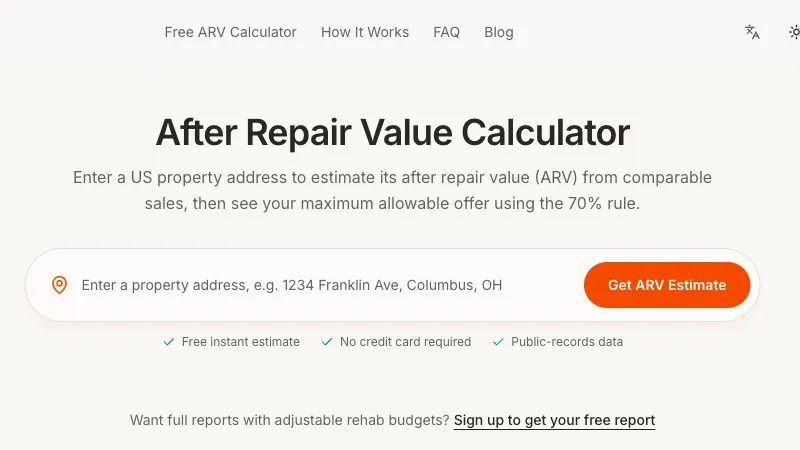
Step 1: Input Property Address
Begin by entering any US residential address into the free ARV calculator:
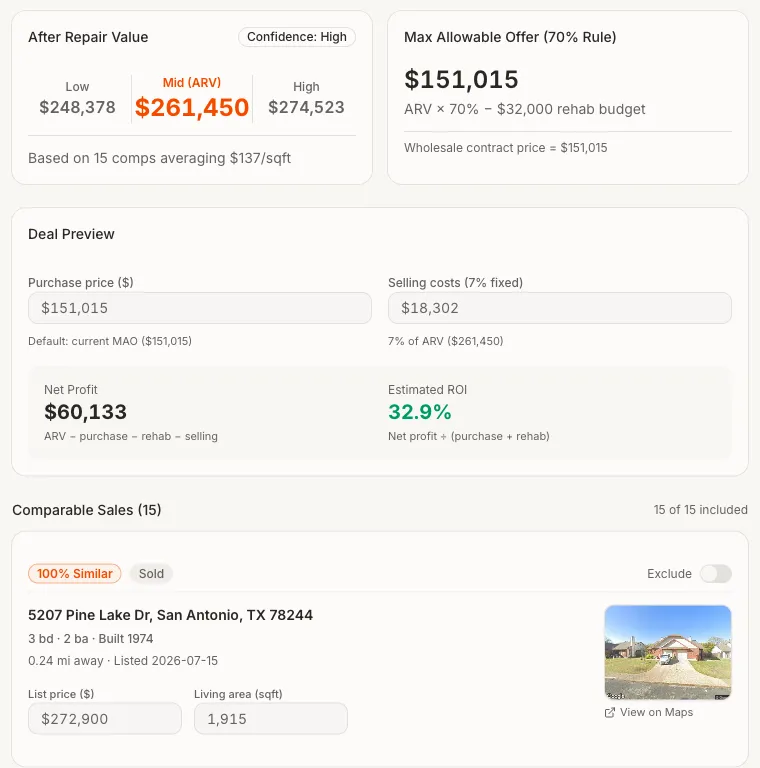
Step 2: Review and Filter Verified Comparable Sales
ARVHQ automatically pulls verified closed sales from public county records. You can evaluate comps side-by-side, examining sale dates, distances, square footage, and condition adjustments:

Filter out non-arm's-length transfers, outdated transactions, or distress sales to establish a true market benchmark that aligns with what a bank appraiser will evaluate during your refinance.
Step 3: Run Maximum Acquisition and Refinance Projections
Once your comparable properties are calibrated, review the automated valuation tiers and offer calculations:
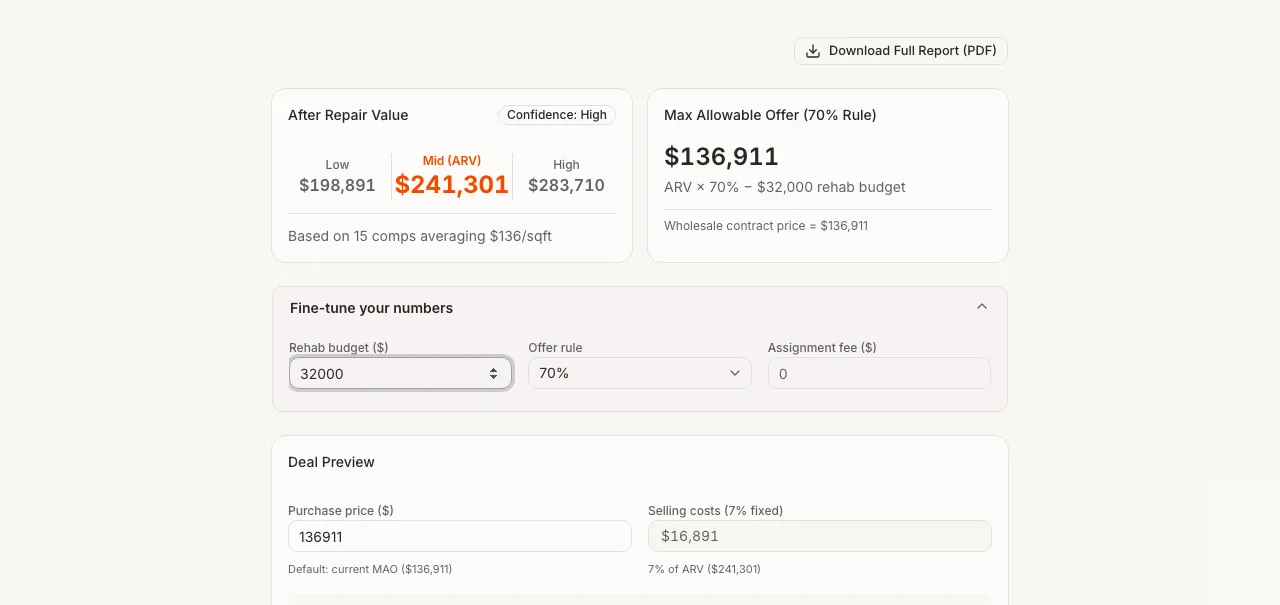
By inputting your estimated renovation budget and adjusting your target loan-to-value percentage, you can verify whether the deal meets your capital extraction threshold before submitting a binding offer:
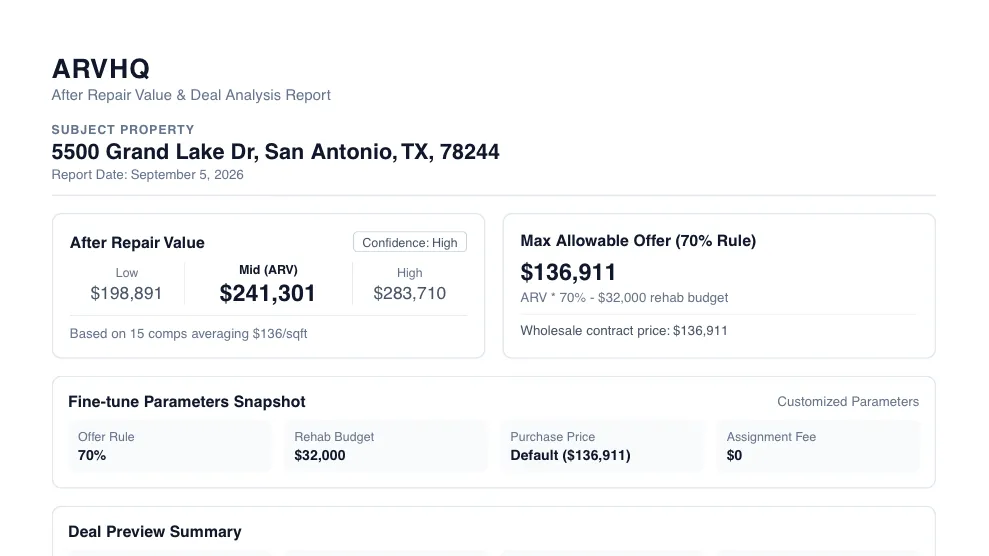
Step 4: Export Defensible Deal Dossiers for Lenders
Presenting clear underwriting documentation to private money partners, hard money lenders, and takeout underwriters accelerates loan approvals. ARVHQ generates comprehensive property dossiers with a single click:
A note on transparency: ARVHQ is operated by the team behind this article, and its comps come from RentCast's nationwide database of public county-recorded sales — not real-time MLS feeds. Data sources and AI involvement are described on our AI disclosure page. New accounts get three free reports, and for high-stakes deals we always recommend verifying any automated estimate against your own comp check or a licensed appraisal. Utilizing ARVHQ makes applying the BRRRR strategy disciplined and predictable on every transaction.
Frequently Asked Questions
How does the brrrr method work?
The BRRRR method works by converting short-term equity creation into long-term mortgage capital across a five-phase cycle: Buy an undervalued property at a discount, Rehab the structure to increase appraisal value, Rent the unit to reliable tenants, Refinance with a long-term mortgage to recover your original cash, and Repeat the process using the recycled capital. By achieving an appraised After Repair Value where a 75% loan-to-value mortgage equals your total capital invested, you recover one hundred percent of your funds while retaining a cash-flowing rental asset.
What is the ideal LTV for a BRRRR cash-out refinance?
The ideal loan-to-value ratio for a BRRRR cash-out refinance is between 70% and 75% of the property's appraised value. While some credit unions and specialized portfolio lenders occasionally allow up to 80% LTV, a 75% ceiling represents the institutional standard for conventional Fannie Mae and commercial DSCR loans. Underwriting your deals to a conservative 70% to 75% LTV leaves a necessary safety buffer against appraisal variances while ensuring the property generates healthy net monthly rental cash flow after debt service.
How do you calculate the maximum purchase price for a BRRRR property?
You calculate the maximum purchase price for a BRRRR property by multiplying the projected After Repair Value by your lender's maximum cash-out loan-to-value percentage, then subtracting your estimated renovation budget, holding costs, and refinance financing fees: Maximum Purchase Price = (ARV × Target LTV) − Rehab Costs − Carrying Costs − Refinance Fees. To extract all of your invested cash at refinancing, your total initial capital outlay cannot exceed the final loan proceeds disbursed by the takeout lender.
What is the seasoning period in a BRRRR refinance?
The seasoning period in a BRRRR refinance is the mandatory timeframe a borrower must hold title to a property before a lender will calculate cash-out loan amounts based on a new appraised value rather than the original purchase price. Under standard conforming conventional mortgage rules, seasoning guidelines require 6 to 12 months of recorded title ownership. However, many specialized private and DSCR rental lenders offer shortened seasoning windows of 90 to 180 days once the property is renovated and stabilized with a paying tenant.